
Why Is My Upper Back So Itchy? A St. Louis Dermatologist Explains Causes & Solutions
That nagging, unreachable itchy upper back is more than just a minor annoyance. For many residents in St. Louis, from Ladue to Chesterfield, it’s a frustrating message from your skin—a signal that something’s off and needs a closer look. An itchy back is an incredibly common source of frustration, and figuring out what's causing it is the first real step toward relief.
What You Need to Know: A Quick Overview
Common Causes: The most frequent culprits for an itchy upper back include dry skin (xerosis), contact dermatitis from clothing or laundry detergent, and chronic conditions like eczema or psoriasis.
Hidden Causes: Sometimes, the itch isn't on the skin's surface. Nerve-related issues like Notalgia Paresthetica can cause a "phantom itch" in one specific spot, often under a shoulder blade.
At-Home Relief: Simple steps like using fragrance-free moisturizers, taking lukewarm showers, and applying cool compresses can provide significant relief for mild cases.
When to See a Doctor: If the itch lasts more than two weeks, disrupts your sleep, is accompanied by a spreading rash, or doesn't improve with at-home care, it's time to consult a board-certified St. Louis dermatologist.
Decoding That Unreachable Upper Back Itch

It usually starts small, maybe a faint tickle right between the shoulder blades that you can barely reach. Before you know it, it's a constant, maddening itch that has you searching for the nearest doorframe to scratch against. If that sounds familiar, you're in good company.
In fact, one major study published in Itch (2021) revealed that the lifetime prevalence of chronic itch is a staggering 22%. It’s a reminder of just how widespread this irritating symptom really is. You can read the full research about itch prevalence here.
Here at Mid-County Dermatology, our board-certified St. Louis dermatologists, Dr. Feigenbaum and Dr. Gibstine, have helped countless patients from Clayton to Creve Coeur finally get some peace. As leading St. Louis skin specialists, they've seen it all and understand that an itchy back can spring from a whole host of issues.
What Is Your Skin Trying to Tell You?
Think of a persistent itch as your body's version of a "check engine" light. It's an alert that something needs a proper diagnosis from a qualified St. Louis skin doctor. Just ignoring it—or worse, scratching it raw—can often make the underlying problem worse.
So, what could be going on? The potential culprits fall into a few main categories:
Skin-level issues: This is the most common group and includes things like dry skin, contact dermatitis, eczema, or even a fungal infection like tinea versicolor. You can learn more about tinea versicolor in our detailed guide.
Nerve-related causes: Sometimes, the problem isn’t actually the skin itself. Instead, it’s the nerves in that area sending faulty "itch" signals to the brain.
Systemic conditions: Less often, a nagging itch can be a symptom of an internal health issue that needs to be addressed.
Throughout this guide, we'll walk through these causes one by one. Our goal is to empower residents in Frontenac, Ladue, and the greater St. Louis area to understand what their skin is telling them and know exactly when it’s time to see an expert from our St. Louis dermatology practice.
Uncovering the Most Common Culprits on Your Skin's Surface

More often than not, the reason for an itchy upper back is exactly what it feels like—a problem on the surface of your skin. Our dermatologists often tell patients to think of their skin as a strong brick wall. When that wall is well-hydrated and its mortar is intact, it keeps irritants out. But when it gets compromised, a persistent itch can sneak in.
Dry Skin: The Usual Suspect
The most common and straightforward cause of an itchy back is simply dry skin, or what we call xerosis in the medical world. When your skin loses moisture, it develops tiny, invisible cracks. These small openings allow irritants to penetrate the skin barrier easily, which is what triggers that nagging itch response.
Here in St. Louis, the weather is a huge factor. The dry, cold winter air in Creve Coeur and Chesterfield is notorious for stripping moisture from the skin. And don’t be fooled by summer—constant air conditioning can dry you out just as effectively.
Contact Dermatitis: When Your Skin Protests
Sometimes, the itch is your skin's way of telling you it doesn't like something it touched. This reaction is called contact dermatitis. At Mid-County Dermatology, we help patients pinpoint these culprits all the time.
Common suspects for an itchy upper back often include:
Laundry Detergents: Lingering fragrances and dyes in soaps can stay on your clothes and irritate the skin.
Fabric and Tags: Rough fabrics like wool or scratchy clothing tags can cause simple friction and irritation.
Metal Clasps: Nickel is a very common allergen and is frequently found in bra clasps.
Backpacks and Bags: When sweat gets trapped under the straps of a backpack, it creates the perfect storm of moisture and friction.
Getting to the bottom of these triggers is the key to relief. If this sounds familiar, you can get a more detailed breakdown in our guide on what is dermatitis from a St. Louis dermatologist's perspective.
Chronic Conditions: Eczema and Psoriasis
For some people, an itchy upper back is a sign of a chronic inflammatory skin condition. These aren’t simple issues—they involve a miscommunication with the immune system.
At Mid-County Dermatology, Dr. Feigenbaum and Dr. Gibstine frequently see patients from across the St. Louis area, including Frontenac and Ladue, whose persistent back itch is the first sign of an underlying condition like eczema or psoriasis that requires a targeted treatment plan.
Eczema (Atopic Dermatitis) usually shows up as dry, scaly patches that are intensely itchy. While we often see it in the crooks of arms and knees, it can absolutely appear on the back.
Psoriasis, on the other hand, is an autoimmune condition where skin cells build up way too fast. This pile-up forms thick, silvery scales and itchy, sometimes painful, dry patches. Evidence from the American Academy of Dermatology (AAD) confirms that pruritus (itch) is a dominant symptom in over 70-90% of psoriasis patients.
Folliculitis and Fungal Infections
Finally, we have to consider issues that start in the hair follicles or from a fungal invader.
Folliculitis is when hair follicles become inflamed, often because of a bacterial or fungal infection. It looks like small, red, pimple-like bumps that can be incredibly itchy.
A fungal infection, like ringworm (tinea corporis), can also cause that classic ring-shaped, scaly, and itchy rash on the back. These infections love warm, moist environments, which is why good hygiene after a workout is so important.
When the Itch Is More Than Skin Deep
While many itchy backs start at the skin's surface, sometimes the problem comes from much deeper. The issue isn't always the skin itself, but a faulty signal from your nerves or even another part of your body.
This kind of nerve-driven itch is called neuropathic itch. Research published in the Journal of the American Academy of Dermatology suggests it may be behind a significant number of chronic itch cases. Here at Mid-County Dermatology, our St. Louis skin specialists are trained to spot the signs that an itch is more than just a simple rash.
Notalgia Paresthetica: The Phantom Itch
One of the most common causes of a chronic, localized itch on the upper back is a condition called Notalgia Paresthetica. If you have a relentless itch in one specific spot, usually just under a shoulder blade, this could be the culprit.
What makes Notalgia Paresthetica so maddening is that the skin often looks completely normal. There’s no rash to see. The root cause isn't on the surface; it's believed to be caused by irritation or a pinched nerve branching out from the spine, which then misfires and sends constant itch signals.
When an Itch Signals an Internal Issue
Less often, a widespread itch can be your body waving a red flag about an internal, or systemic, health issue. This is exactly why a persistent itch without a clear cause should never be brushed off.
Several internal diseases can make your whole body feel itchy:
Liver Disease: When the liver isn't working right, bile salts can build up in your bloodstream.
Kidney Disease: Failing kidneys can't filter waste products properly, causing a severe, body-wide itch called uremic pruritus.
Thyroid Problems: Both an overactive (hyperthyroidism) and underactive (hypothyroidism) thyroid can disrupt skin function.
"A persistent itch without a rash is a puzzle that a board-certified dermatologist is uniquely equipped to solve. At our St. Louis dermatology practice, we investigate every possibility—from nerves to systemic health—to find the true source of your discomfort." — Dr. Feigenbaum, Mid-County Dermatology
Shingles: A Painful Viral Culprit
Finally, another cause that runs deeper than the skin is Shingles (herpes zoster). Shingles happens when the chickenpox virus reactivates in your nerve cells. It typically causes a painful, blistering rash that wraps around one side of your torso, often hitting the upper back.
Before any blisters show up, the first sign is often an intense burning, tingling, or itching feeling in that area. If you suspect Shingles, seeing a St. Louis skin doctor right away is critical.
Actionable Steps: Strategies for At-Home Relief
When that nagging itch on your upper back just won't quit, finding relief at home is the first line of defense. For many people in St. Louis, a few simple, consistent adjustments can make a huge difference.
Soothing Your Skin Directly
The goal here is to calm the skin's surface and break that maddening itch-scratch cycle.
Proper Moisturization: After a shower, gently pat your skin so it’s still slightly damp. Immediately apply a thick, fragrance-free, hypoallergenic cream to trap moisture in your skin. For more local tips, check out our guide to combating St. Louis dry skin.
Cool Compresses: Soak a clean washcloth in cool water and lay it across the itchy spot for 15-20 minutes. The coolness helps numb the nerve endings.
Oatmeal Baths: A colloidal oatmeal bath helps reduce inflammation. Add it to a lukewarm (not hot!) bath and soak for about 15 minutes.
Lifestyle Adjustments and Over-the-Counter Options
Beyond what you put directly on your skin, some simple product swaps and habit changes can protect you from common triggers.
Switch Your Detergent: The dyes and perfumes in many laundry detergents are notorious irritants. Switch to a "free and clear" version.
Choose Breathable Fabrics: Stick with soft, natural fabrics like cotton or bamboo. They let your skin breathe and are less likely to cause irritation.
Take Cooler, Shorter Showers: Hot water strips away the natural oils that form your skin's protective barrier. Keep showers lukewarm and try to cap them at 10 minutes.
Use OTC Products Wisely: A 1% hydrocortisone cream can help with small, inflamed patches but isn't for long-term use (stick to a week or two). For suspected allergies, an oral antihistamine might be a better choice.
If the area feels sore and tense, some people find comfort from gentle warmth. Applying microwavable heat therapy pads for the upper back can be a good way to soothe tense muscles, which can sometimes contribute to the discomfort.
When to See a Dermatologist
While sorting out a minor itch at home is often the first step, how do you know when it’s time to call in a professional? Knowing when that annoying itch crosses the line from a simple nuisance to a red flag is key to getting real, lasting relief. A board-certified St. Louis Dermatologist has the expertise to figure it out accurately.
Clear Signs It's Time for a Professional Consultation
For anyone in St. Louis and the surrounding areas like Clayton, Ladue, or Chesterfield, the expert team at Mid-County Dermatology is here to help.
It’s time to schedule an appointment if you’re experiencing any of these issues:
The itch lasts longer than two weeks despite your best efforts.
It's so intense that it’s disrupting your sleep or daily life.
The itch comes with a spreading rash, blisters, or open sores.
You’re noticing other symptoms like a fever, fatigue, or unexplained weight loss.
If you're on the fence, our article on the top signs you should see a dermatologist can offer more clarity.
Self-Care vs. Dermatologist Visit Decision Framework
This simple checklist is designed to help you determine the best course of action.
Symptom or Situation | Try Self-Care First | Schedule a Dermatology Appointment |
|---|---|---|
Mild itchiness after sun exposure | ✔️ | |
Dry, flaky skin without a rash | ✔️ | |
Itch lasts more than 2 weeks | ✔️ | |
Rash is spreading or changing | ✔️ | |
Over-the-counter creams aren't working | ✔️ | |
Itch is severe enough to wake you up | ✔️ | |
Signs of infection (pus, warmth, sores) | ✔️ | |
Itch accompanied by fever or fatigue | ✔️ |
Ultimately, a professional evaluation is always the safest and most effective path forward for a persistent itch.
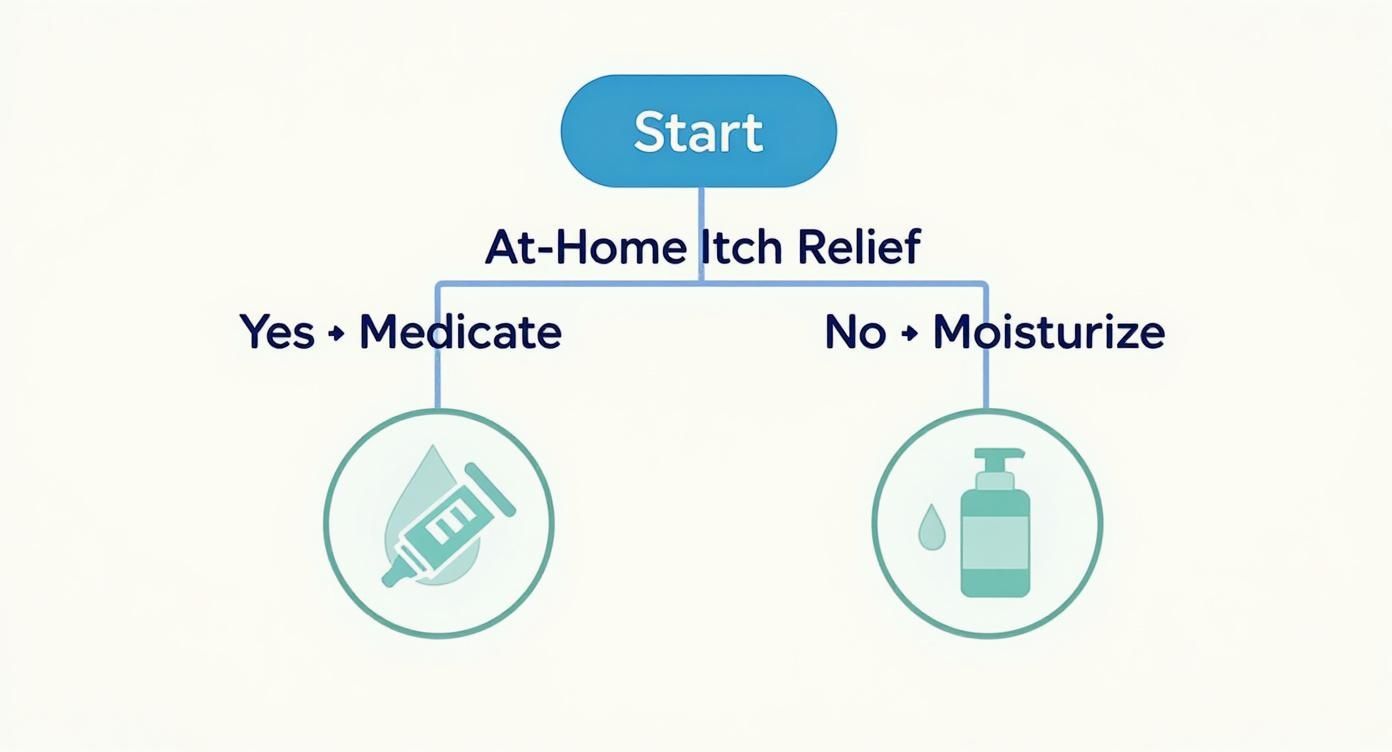
As the flowchart shows, the presence of a rash is a major clue that helps you decide your next step. If these first steps don't bring relief, it’s another strong signal that it’s time for a professional evaluation with a St. Louis skin specialist.
What to Expect at Your Dermatology Visit

Walking into a specialist's office can feel intimidating, but at Mid-County Dermatology, our whole approach is designed to make your visit comfortable and productive.
Your consultation starts with a conversation. Dr. Feigenbaum or Dr. Gibstine will listen to your story, asking when the itch started, what it feels like, what you’ve already tried, and about your overall medical history.
The Diagnostic Journey
After hearing your story, your St. Louis dermatologist will conduct a thorough skin examination. Depending on what they see, they might use simple diagnostic tools:
Skin Scraping: If a fungal infection seems possible, your doctor might gently scrape a few skin cells to look at under a microscope.
Patch Testing: For a suspected allergic reaction, patch testing involves applying small patches with common allergens to your skin to identify the trigger.
Skin Biopsy: In some situations, a small sample of skin may be taken for a closer look in a lab to diagnose more complex conditions.
Our diagnostic process is meticulous for a reason. A precise diagnosis is the cornerstone of effective treatment. We don’t just want to treat the itch; we want to find and fix its root cause to give you lasting relief.
Creating Your Personalized Treatment Plan
Once we have a clear diagnosis, Dr. Feigenbaum or Dr. Gibstine will craft a treatment plan just for you. For our patients from Creve Coeur to Ladue, a plan might include advanced topical creams, oral medications, light therapy, or specific lifestyle adjustments—all tailored to finally get your itchy upper back under control.
Key Takeaways
An itchy upper back can stem from simple causes like dry skin or more complex issues like nerve irritation or underlying health conditions.
At-home care is effective for mild cases and includes moisturizing, cool compresses, and avoiding irritants.
Professional diagnosis from a St. Louis dermatologist is crucial if the itch is severe, persistent, or accompanied by a rash or other symptoms.
Personalized treatment at Mid-County Dermatology ensures you receive the most effective care for your specific condition, moving beyond guesswork to provide real relief.
Frequently Asked Questions (FAQ)
Our trusted St. Louis skin specialists, Dr. Feigenbaum and Dr. Gibstine, answer some of the most frequent questions they hear from patients.
What causes an itchy upper back?
The most common causes are dry skin (xerosis), contact dermatitis from irritants like laundry detergent or scratchy fabrics, and skin conditions like eczema or psoriasis. Less common causes include nerve issues like Notalgia Paresthetica or underlying systemic diseases.
Can stress make my upper back itch?
Absolutely. When you're under stress, your body releases chemicals like histamine, which can trigger itching even without a rash. This is sometimes called a psychogenic itch. A dermatologist at our St. Louis office can help rule out other causes.
Could my itchy back be a sign of skin cancer?
While not the most common symptom, certain skin cancers can appear as a spot that won't stop itching or seems unable to heal. If you have a specific lesion that is constantly itchy, changing, bleeding, or sore, it is critical to get it checked by a board-certified St. Louis dermatologist at Mid-County Dermatology.
Why is it so hard to satisfy an itch on my back?
The skin on your upper back has fewer nerve endings than areas like your fingertips. This makes it harder for your brain to pinpoint the exact source of the itch, leading to that frustrating, deep-seated feeling that scratching barely touches.
Is it okay to use over-the-counter anti-itch creams long term?
It depends. Standard moisturizers are safe for daily, long-term use. However, creams containing 1% hydrocortisone are for short-term relief (a week or two at most). Long-term use can thin the skin. For any persistent itch, it's best to get a professional diagnosis from a qualified St. Louis skin doctor.
Don't let a persistent itchy back disrupt your life. The board-certified dermatologists at Mid-County Dermatology are here to provide an accurate diagnosis and a personalized treatment plan for lasting relief. Schedule your consultation today by visiting https://www.midcountyderm.com.
This information is for educational purposes only and does not constitute medical advice. Please consult with Dr. Feigenbaum, Dr. Gibstine, or another qualified healthcare provider at Mid-County Dermatology for personalized treatment recommendations. Individual results may vary.


Comments