
What Are Signs of Melanoma? Key Symptoms You Should Know
Noticing a new spot on your skin or seeing an old mole change can be unsettling. For many of our patients, the first question is always, "What are the signs of melanoma?"
Early detection is the most powerful tool you have. When found in its initial stages, melanoma is highly treatable. This guide will help you understand the key symptoms and feel confident about when to seek a professional evaluation.
What You Need to Know
For those looking for a quick overview, here are the essential points about identifying potential melanoma:
The ABCDE Rule: This is the primary method for self-checks. Look for Asymmetry, irregular Borders, varied Color, Diameter larger than a pencil eraser, and any spot that is Evolving or changing.
The "Ugly Duckling" Sign: Trust your instincts. If a mole looks different from the others on your body—even if it doesn't fit the ABCDE criteria—it's worth getting checked.
Other Symptoms: Pay attention to sores that won't heal, new itching or bleeding from a mole, or pinkish bumps that don't go away.
When to Act: Any spot that worries you or fits the warning signs should be examined by a board-certified dermatologist like Dr. Feigenbaum or Dr. Gibstine at Mid-County Dermatology.
One of the classic hallmarks of melanoma is a new mole appearing or an old one changing. While melanoma accounts for about 1% of all skin cancers, it causes the majority of skin cancer deaths, according to research from 2022. You can learn more about melanoma statistics and see why early detection is so critical.
The ABCDE Signs of Melanoma at a Glance
This quick-reference table is a great tool to keep in mind during your skin self-checks. It breaks down exactly what each letter in the ABCDEs stands for and what you should be looking for.
Letter | Stands For | What to Look For in a Mole |
|---|---|---|
A | Asymmetry | One half of the spot doesn't match the other half. |
B | Border | The edges are uneven, scalloped, or poorly defined instead of smooth. |
C | Color | The color isn't uniform. You might see shades of brown, black, tan, white, red, or even blue. |
D | Diameter | The spot is larger than 6 millimeters across, which is about the size of a pencil eraser. |
E | The mole just looks different from your others, or it's actively changing in size, shape, or color. |
If a mole on your skin checks one or more of these boxes, it’s a clear signal that it's time to have it evaluated by a dermatologist.
Breaking Down the ABCDEs of Melanoma
The ABCDEs are a simple yet powerful language your skin uses to communicate with you. It’s a straightforward mnemonic, highly recommended by the American Academy of Dermatology, that helps you spot potentially dangerous moles.
Knowing these signs is the first step toward getting a professional evaluation from a dermatologist like Dr. Feigenbaum or Dr. Gibstine at Mid-County Dermatology. Let's walk through what each letter really means when you're doing a skin check.
A is for Asymmetry
Picture a line drawn straight through the middle of one of your moles. In a healthy, benign mole, both halves should be a pretty good mirror image of each other.
The first major red flag for melanoma is Asymmetry—when one half just doesn't match the other in size or shape. That kind of imbalance is a clear signal that the mole needs a closer look.
B is for Border
Next, trace the edges of the mole with your eye. A harmless mole usually has a smooth, clean, well-defined border.
When a mole is suspicious, its Border often looks irregular, blurry, scalloped, or even notched. It’s like an edge you couldn’t trace cleanly with a pen.
C is for Color
A normal mole is typically one solid, uniform color, usually some shade of brown. The real warning sign here is variation in Color.
If a single mole is a patchwork of different shades of brown, tan, and black, or if you see splotches of red, white, or blue, that’s a significant concern. You can learn more about what to look for when examining suspicious moles on our website.
This visual is a great reference for the key warning signs to look for during a self-check.
It really drives home how asymmetry, an irregular border, and varied color are the first things that should catch your eye and tell you a mole might be abnormal.
D is for Diameter
Size definitely matters when it comes to moles. While it’s true that melanomas can start out small, a classic warning sign is a Diameter larger than 6 millimeters.
To put that in perspective, that’s about the size of a standard pencil eraser. Any mole that hits or grows past this size should be monitored carefully and brought to your dermatologist's attention.
E is for Evolving
This last letter, Evolving, is arguably the most critical of all. Any change you notice in a mole—whether it happens over weeks or months—is a valid reason to schedule an appointment.
This isn't just about size; it includes any changes in its shape, color, or elevation. New symptoms like bleeding, itching, or crusting are also part of the "Evolving" warning sign.
Looking Beyond the ABCDEs for Other Warning Signs
The ABCDEs are an excellent starting point, but some melanomas don't play by the rules. Here at Mid-County Dermatology, we always remind our St. Louis patients to be aware of other subtle signs.
Not every dangerous spot is going to be large, dark, and obviously asymmetrical.
One of the most powerful tools you have is your own intuition, which is what the "Ugly Duckling" rule is all about. Put simply, it’s any mole that just looks out of place compared to the others on your body.
It might be smaller, larger, lighter, or darker—it just doesn't fit in. Often, your own eye will be drawn to it because it stands out from the crowd.
Less Common but Crucial Symptoms
It's also critical to know what else to look for beyond a mole’s basic appearance. These additional red flags for melanoma can be just as important:
Amelanotic Melanoma: This is a sneaky type of melanoma because it has no dark pigment. It can show up as a pinkish, reddish, or even skin-colored bump, making it easy to dismiss as a simple pimple or cyst.
A Sore That Won't Heal: Pay close attention to any spot that bleeds, oozes, or crusts over but never seems to fully heal. Healthy skin knows how to repair itself; cancerous lesions don't.
New or Unusual Sensations: If a mole suddenly develops new symptoms like itching, tenderness, or pain, that’s a warning sign. A spot that has been quiet for years shouldn't suddenly become uncomfortable.
Ultimately, the clinical sign of evolution—any change in a mole's size, shape, color, or new symptoms like itching or bleeding—is the single most important predictor of a potential malignancy. Research published in 2024 emphasizes that these early warning signs are especially vital in older populations, who are hit hardest by melanoma. You can read the full research on melanoma warning signs to get a deeper understanding of why tracking these changes matters so much.
"Your intuition about your skin is powerful. If a spot just feels 'off' or doesn't look like anything else you have, that's reason enough to get it checked by a board-certified dermatologist."
Understanding Your Personal Risk for Melanoma
Knowing what a suspicious mole looks like is one half of the battle. The other half is understanding your own personal risk factors for developing skin cancer.
Certain things can make proactive skin care and regular professional screenings absolutely critical. At Mid-County Dermatology, we work with our St. Louis patients to help them get a clear picture of their unique risk profile.
There are several key factors that can elevate your risk, and it’s important to be honest about where you stand with each.
Key Melanoma Risk Factors
UV Exposure: This is the big one. Frequent, intense sun exposure or any use of indoor tanning beds is the primary driver of melanoma.
Sunburn History: Just one blistering sunburn in childhood or adolescence can actually more than double your chances of developing melanoma later in life.
Skin Type: People with fair skin, freckles, light-colored eyes, and red or blonde hair are naturally at a higher risk.
Mole Count: Having more than 50 moles is a known risk factor, as is having atypical moles (what dermatologists call dysplastic nevi).
Personal or Family History: If you've had melanoma before, or if a close blood relative has had it, your own risk increases significantly.
Unfortunately, melanoma diagnoses are becoming more common. Projections estimate a staggering 212,200 new cases in the United States in 2025 alone. Reading more about these melanoma statistics really highlights why awareness and prevention are so vital.
While some of our St. Louis neighbors might have a higher genetic risk, melanoma can and does affect people of all skin tones. Protecting your skin is a universal necessity. A great place to start is by following our sunscreen tips.
When to Schedule a Professional Skin Exam
Self-checks are your first line of defense, but there's no substitute for a dermatologist’s trained eye. Knowing exactly when to pick up the phone is critical for catching potential problems early.
The moment you shift from simply watching a spot to actively worrying about it is the moment to act.
Here at Mid-County Dermatology, our board-certified dermatologists, Dr. Feigenbaum and Dr. Gibstine, strongly recommend scheduling an appointment as soon as you notice any warning signs.
Clear Triggers for a Dermatologist Visit
Don't hesitate to book a visit if a mole or spot on your skin meets any of these criteria:
It checks any of the ABCDE boxes. Asymmetry, a funky border, weird colors, a diameter bigger than a pencil eraser, or any evolution are direct signals to get an expert opinion.
It’s an "Ugly Duckling." If a mole just doesn't look like the others on your body, that difference alone is a good reason to have it examined.
It's new, changing, or just feels wrong. Pay attention to new symptoms like itching, tenderness, bleeding, or a sore that just won’t heal. You know your body best, so trust your gut.
If you have a higher-risk profile—like a family history of skin cancer or a large number of moles—an annual full-body exam is a must. Proactive care is truly the best defense, and our team is ready to help you with a professional skin cancer screening.
The simple, reassuring message is this: when in doubt, get it checked out. An expert evaluation provides peace of mind, and early detection saves lives.
Sometimes it's helpful to have a clear guide on what to do next. This table can help you decide when to keep an eye on things and when to call us right away.
Self-Check vs Professional Exam: When to Act
Symptom or Concern | Your Next Step | Level of Urgency |
|---|---|---|
A stable mole that hasn't changed in years. | Continue monthly self-checks. | Low |
A new mole appears on your skin. | Monitor it for a few weeks for any changes. If it evolves, call for an appointment. | Medium |
A mole starts itching, bleeding, or becomes tender. | Schedule an appointment with your dermatologist promptly. | High |
A mole fits one or more of the ABCDE criteria. | Call for an appointment immediately. | High |
You just have a "bad feeling" about a spot. | Trust your intuition and schedule a visit for peace of mind. | Medium to High |
You have a personal or family history of skin cancer. | Schedule a routine annual exam, and call sooner if you notice anything new or changing. | Routine (High Priority) |
Deciding to act is the most important step. A professional exam can either put your mind at ease or, if needed, start the process for early, effective treatment.
Once you have scheduled your professional skin exam, receiving timely notifications, like those provided by helpful guides on patient appointment reminders, can ensure you never miss this vital check-up.
Key Takeaways
Know the ABCDEs: This simple mnemonic is your most effective tool for at-home skin checks. Look for Asymmetry, Border irregularity, Color variation, Diameter over 6mm, and Evolution.
Look for the "Ugly Duckling": Any spot that looks different from the others on your body warrants a closer look from a professional.
Action is Key: If you notice any warning signs or have a spot that worries you, don't wait. Early detection dramatically improves outcomes for melanoma.
Prevention is Powerful: Daily sunscreen use, seeking shade, and avoiding tanning beds are crucial steps in reducing your risk.
Frequently Asked Questions About Melanoma
To give you more clarity, we've answered some of the most common questions our dermatologists at Mid-County Dermatology hear from patients in the St. Louis area.
Can a mole that is not dark be melanoma?
Yes, absolutely. While we often look for dark, suspicious spots, a less common type called amelanotic melanoma doesn't produce pigment. It can show up as a pink, red, or even skin-colored bump that doesn't heal.
This is why it's so important to monitor any new or changing spot, not just the dark ones. If you have a persistent pinkish lesion that bleeds or refuses to go away, that’s a clear signal to have it checked out.
What happens during a professional skin check?
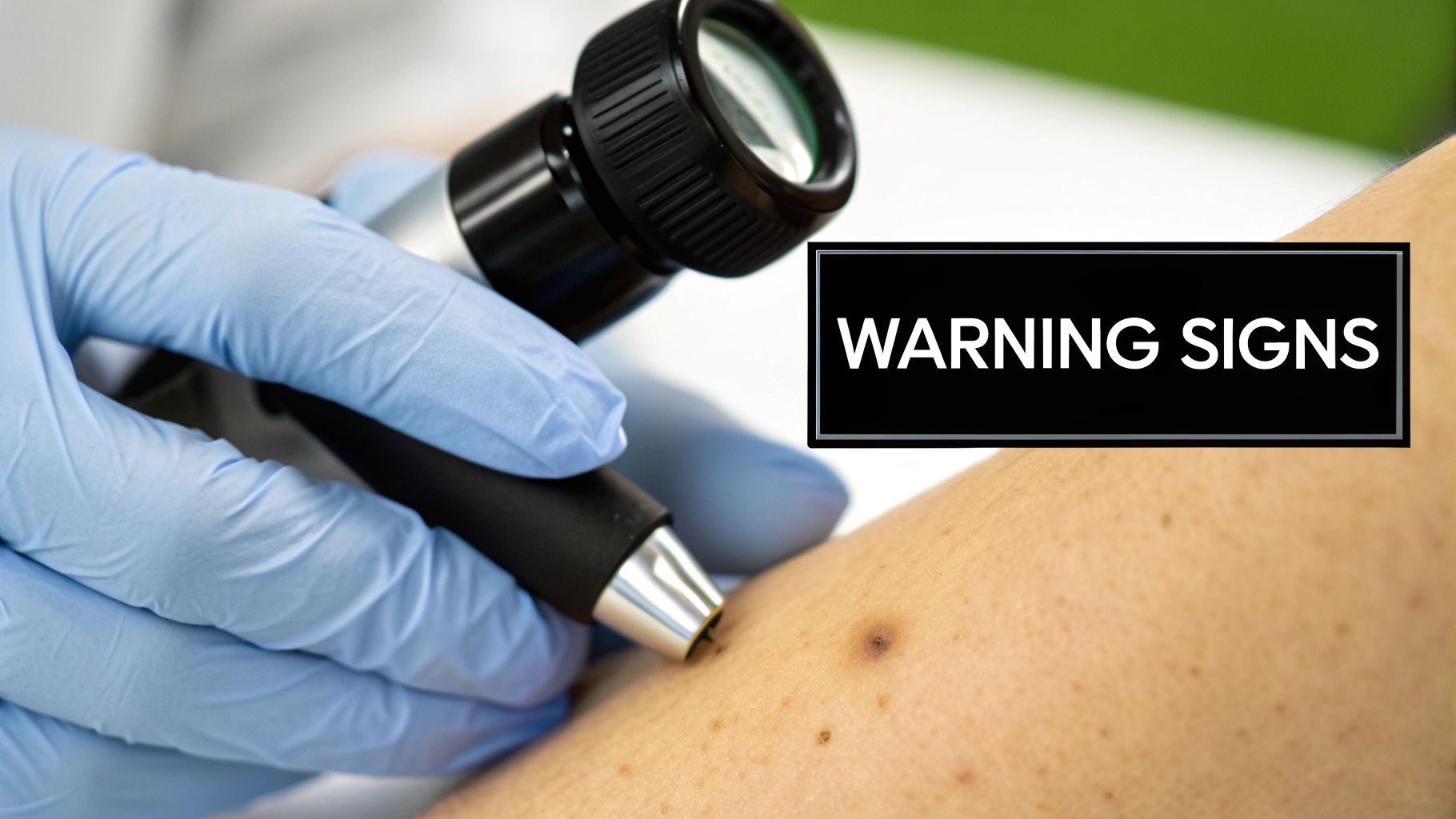
When you come into Mid-County Dermatology for a skin exam, you can expect a thorough, head-to-toe evaluation. Dr. Feigenbaum or Dr. Gibstine will carefully check areas you can't easily see yourself, like your scalp, back, and between your toes.
They may use a dermatoscope—a special magnifying tool—for a closer look. If a lesion is concerning, they might suggest a biopsy, which involves taking a tiny tissue sample to be analyzed in a lab. We do everything we can to make the process as comfortable as possible.
If a mole is removed, does that mean it was cancer?
Not at all. Dermatologists often remove suspicious moles, called atypical nevi, that turn out to be completely benign (non-cancerous). This is a "better safe than sorry" approach.
The only way to know for certain is with a biopsy. The key takeaway is that early removal and diagnosis are everything. The prognosis for early-stage melanoma is excellent when it's caught and treated promptly.
What is the best way to prevent melanoma?
Your best defense against skin cancer is a smart, multi-layered prevention strategy. It's about making several key habits work together to protect your skin.
Seek Shade: Stay out of direct sun during peak hours, typically between 10 a.m. and 4 p.m.
Use Sunscreen: Make broad-spectrum sunscreen with an SPF of 30 or higher a non-negotiable part of your daily routine.
Wear Protective Clothing: Cover up with wide-brimmed hats, sunglasses, and long-sleeved shirts.
Avoid Tanning Beds: Indoor tanning dramatically increases your risk. Just don't do it.
When you pair these daily habits with monthly self-exams and an annual professional skin check, you're giving yourself the most complete protection possible.
If you've noticed any of the warning signs we've discussed, or if you just have a spot that's worrying you, please don't wait. Schedule your professional skin cancer screening with the expert team at Mid-County Dermatology today. Your peace of mind and skin health are what matter most to us.


Comments