
A Guide to Skin Checks for Melanoma
Catching melanoma early is everything. When you find it in its earliest stages, the 5-year survival rate is an incredible 99%. That statistic alone makes regular skin checks for melanoma one of the most powerful things you can do for your health.

It’s easy to dismiss a new or changing spot on your skin, but proactive monitoring is your single best tool against melanoma. The goal of this guide is to take the anxiety out of that process and replace it with confidence. We’ll show you exactly how to perform a thorough self-exam, what to look for, and when it’s time to call a professional.
Here at Mid-County Dermatology, our board-certified dermatologists, Dr. Feigenbaum and Dr. Gibstine, are dedicated to empowering our patients across the St. Louis area—from Ladue and Clayton to Creve Coeur and Chesterfield—with the knowledge to take charge of their skin health. Think of this guide as your personal playbook for doing just that.
What You Need to Know
We've designed this guide with clear, actionable advice to help you:
Recognize the early warning signs of melanoma.
Feel confident performing monthly skin checks at home.
Know precisely when you need an evaluation from a St. Louis skin doctor.
The hard truth is that anyone can develop skin cancer. We take a deeper dive into this in our article about the skin cancer epidemic in St. Louis. This reality makes routine self-exams a non-negotiable part of your health routine, allowing you to partner with your dermatologist to achieve the best possible outcomes.
Understanding Melanoma and Assessing Your Personal Risk
Melanoma is the skin cancer we take most seriously, and for good reason—it has the potential to spread to other parts of the body. It starts in cells called melanocytes, which make the pigment (melanin) that gives your skin, hair, and eyes their color. While it can be aggressive, understanding your personal risk is the first and most powerful step you can take.
The single biggest culprit? Exposure to ultraviolet (UV) radiation. This is a huge concern for us here during our bright St. Louis summers. Globally, UV exposure is the primary driver behind most melanoma cases. In fact, research published by the International Agency for Research on Cancer in 2022 showed that UV radiation was responsible for the vast majority of cutaneous melanoma cases. You can read the full study on the global burden of melanoma to see the data for yourself.
This evidence-based link is exactly why skin checks for melanoma are so critical for everyone, from Chesterfield to Frontenac.
Key Factors That Increase Your Risk
Anyone can develop melanoma, but some factors definitely raise your personal odds. At Mid-County Dermatology, Dr. Feigenbaum and Dr. Gibstine always encourage patients to look at the whole picture. See where you might fit in with these common risk factors:
Sun Exposure History: Getting just one blistering sunburn in your childhood or teens can more than double your chances of developing melanoma later on, according to the American Academy of Dermatology (AAD).
Skin Type: If you have fair skin that tends to freckle or burn easily, or if you have red or blonde hair and light-colored eyes, you're naturally at a higher risk.
Number of Moles: Having 50 or more common moles is a significant risk factor. The same goes for having any atypical moles—the ones that just look a bit unusual.
Family History: If you or a close family member have had melanoma, your own risk goes up. A first-degree relative (like a parent, sibling, or child) with melanoma is a particularly strong indicator.
As a leading St. Louis Dermatologist practice, we believe knowledge is power. The point of understanding these risks isn’t to cause alarm—it’s to empower you to be proactive about your health. Knowing your personal profile helps you and your skin doctor build the right screening plan for you.
How to Perform a Comprehensive At-Home Skin Exam
One of the single most powerful things you can do for early detection is to perform regular skin checks for melanoma right at home. It’s a simple process that only takes a few minutes, and all you need are a couple of things you likely already have: a full-length mirror and a hand mirror.
The goal is to get to know your skin’s unique landscape—the pattern of moles, freckles, and other spots you have. Nobody knows your body better than you do, which makes you the best person to spot when something is new or has changed.
This is where understanding your personal risk factors and UV exposure really comes into play, leading to this crucial step of checking your skin.
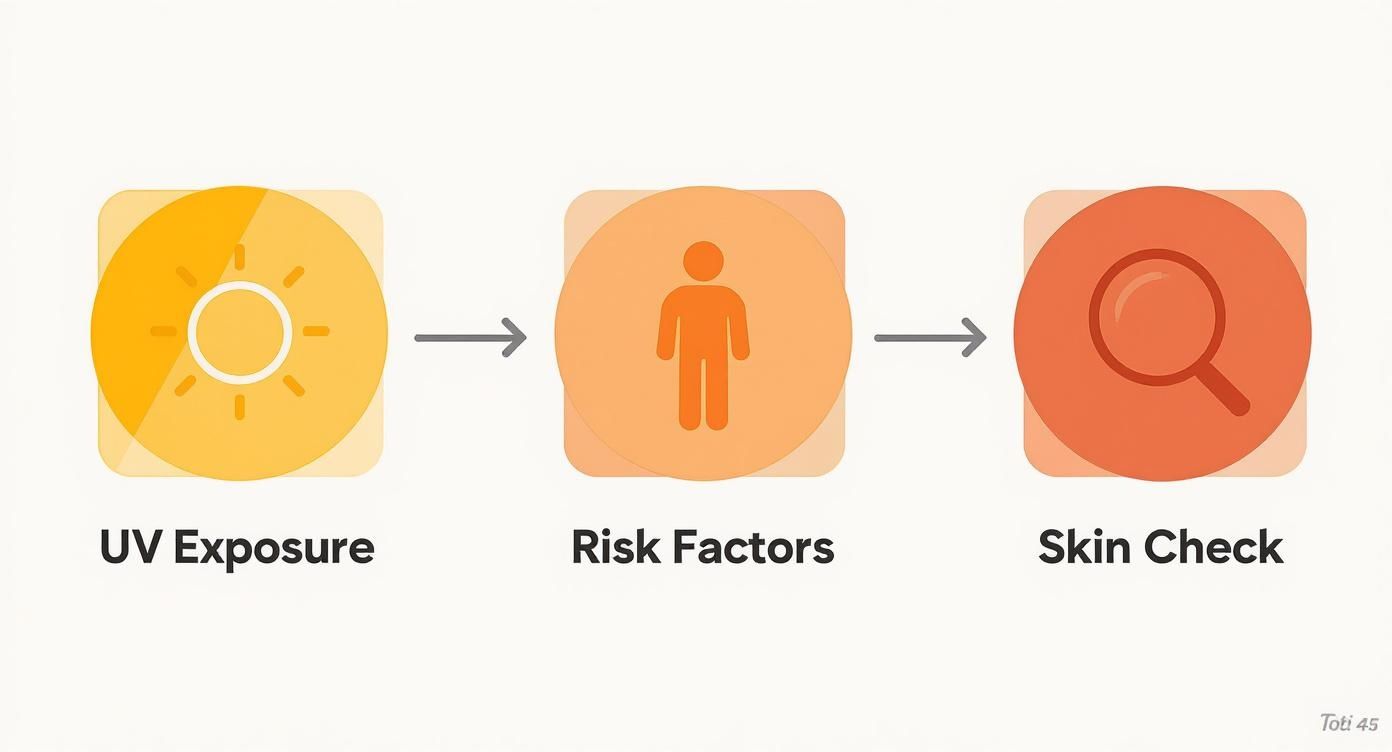
Proactive screening is the logical next step. It's how you take control of your skin health.
Getting Started With Your Self-Exam
Find a room with good, bright lighting and set aside a few minutes once a month for your check. You’ll use the hand mirror to get a good look at hard-to-see areas like your back, reflecting the image into the full-length mirror. It can feel a bit awkward at first, but you'll get the hang of it quickly.
You need to check everywhere. Melanoma can pop up in the most unexpected places, so be thorough.
Face & Neck: Check your face, ears, neck, and scalp. Use a comb or hairdryer to part your hair and inspect your scalp section by section.
Torso: Examine your chest and abdomen. Women should be sure to lift their breasts to check the skin underneath.
Arms & Hands: Check the front and back of your arms, underarms, palms, and the back of your hands. Don't forget to look between your fingers and under your fingernails.
Back & Legs: Use the full-length and hand mirrors to inspect your entire back, buttocks, and the back of your legs.
Feet: Sit down and carefully check the front of your legs, the tops and soles of your feet, and the skin between your toes and under your toenails.
Using the ABCDEs to Spot a Problem
To help guide your exam, dermatologists everywhere use the ABCDEs of Melanoma. Think of it as a simple but incredibly effective checklist for flagging suspicious spots. If any mole or spot on your body ticks one of these boxes, it's a solid reason to schedule an appointment with a St. Louis skin specialist.
A Note from Mid-County Dermatology: "The ABCDEs are an excellent guide, but you should also trust your gut. If a spot just looks 'off' or doesn't seem to fit in with your other moles—what we call an 'ugly duckling'—that alone is a good reason to get it checked out."
The ABCDEs of Melanoma: A Quick Reference Guide
Use this checklist during your self-exam to identify the key warning signs of melanoma. If a mole or spot on your skin exhibits any of these features, it's important to have it evaluated by a board-certified dermatologist at Mid-County Dermatology.
Letter | Stands For | What to Look For (Normal) | What to Look For (Potential Melanoma) |
|---|---|---|---|
A | Asymmetry | Symmetrical; if you drew a line through the middle, both halves would match. | Asymmetrical; one half does not match the other in shape or size. |
B | Border | Smooth, even, and well-defined borders. | Irregular, scalloped, or poorly defined borders that seem to blur into the skin. |
C | Color | A single, uniform color, usually a shade of brown. | Multiple colors, including different shades of brown, black, tan, or even red, white, or blue. |
D | Diameter | Typically smaller than 6mm (the size of a pencil eraser). | Larger than 6mm, although melanomas can sometimes be smaller when first detected. |
E | Evolving | Stays the same in size, shape, and color over time. | Changes in any way—size, shape, color, elevation, or starts to itch, bleed, or crust. |
Knowing what makes a mole typical versus atypical is a huge part of this process. For a closer look at real examples, we’ve put together a guide on how to identify different types of moles on our site. Remember, any concern you have is a valid reason to seek a professional opinion.
Identifying Concerning Changes and When to Take Action
The ABCDEs are a fantastic starting point for your monthly skin checks for melanoma, but the “E” for Evolving is often the most critical one. Any spot that changes—whether in size, shape, color, or texture—is a spot that needs your immediate attention. Think of any change as a signal that something is happening within the skin’s cells.
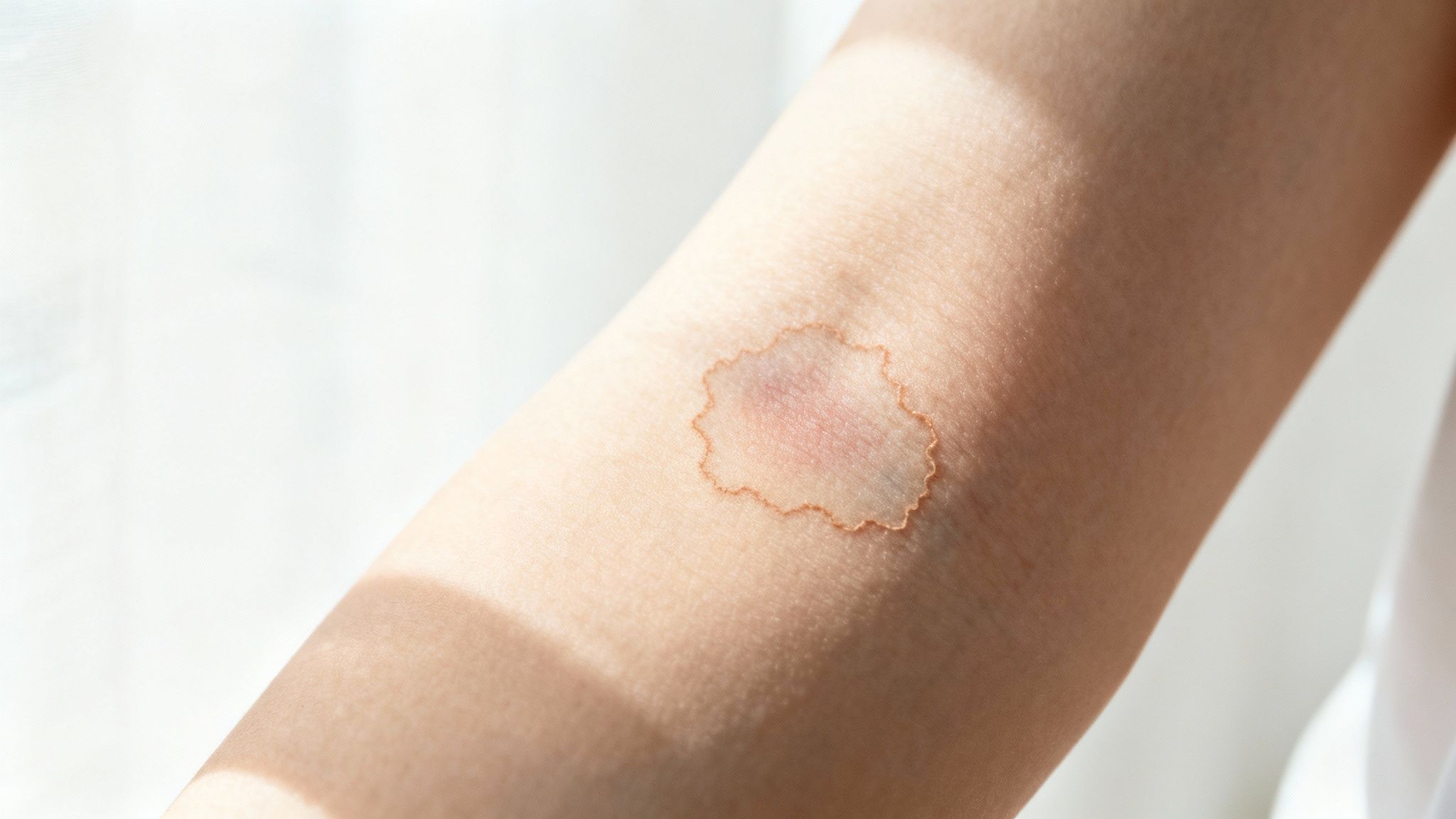
Another powerful concept is the “ugly duckling” sign. As you get to know your skin, you’ll notice that your moles tend to have a certain family resemblance. The ugly duckling is any spot that just doesn't fit in. It might be darker, smaller, or have a totally different texture. You have to trust your instincts here; if a spot feels out of place, it’s worth getting a professional opinion.
What Kind of Changes Should I Look For?
Evolution isn't always dramatic. Here at our St. Louis dermatology practice, we've seen patients from Creve Coeur to Clayton who noticed subtle but important shifts. It's not just about a mole suddenly getting bigger.
Pay close attention to these more subtle warning signs:
New Sensations: Does a mole now itch, feel tender, or become painful when it never did before?
Surface Changes: Is the spot starting to bleed with minor trauma, like from a towel? Is it becoming scaly or developing a crusty surface?
Elevation: Has a previously flat mole started to raise up from the skin?
"A practical tip we always give our patients is to take clear, well-lit photos of your moles with your smartphone. Date them and use them as a reference during your next self-exam. This creates a visual timeline that makes it much easier to track subtle evolution over time." - Dr. Feigenbaum, Mid-County Dermatology.
Any new or changing spot is a valid reason to schedule an appointment. You can learn more about recognizing the key signs of melanoma in our detailed guide. It's always better to be cautious and let a St. Louis skin specialist provide a definitive evaluation.
When to See a Dermatologist: The Value of a Professional Screening
Monthly self-exams are your first line of defense, but they simply can’t replace the expert eye of a board-certified dermatologist. A professional skin check for melanoma is the definitive step in your skin health strategy, offering a level of detail you can't achieve on your own. It's the cornerstone of the care we provide here at Mid-County Dermatology for our patients from Ladue to Creve Coeur.
What makes our exam so different? We use a specialized handheld tool called a dermatoscope. This isn't just a magnifying glass. It uses polarized light to let us see structures and pigment patterns beneath the surface of your skin—details completely invisible to the naked eye. This technology allows us to distinguish between a harmless mole and a potential melanoma with much greater accuracy.
What to Expect During Your Screening
First, know that the process is straightforward, and we do everything we can to make you comfortable. A professional exam is a full-body check, meaning we look at areas you might easily miss, like your scalp, between your toes, and all over your back.
This is especially vital for anyone at high risk or for those who have a tough time doing a thorough self-check. It’s like having a trained expert double-check your work, only with much more advanced tools.
"Many patients feel anxious before their first screening, but they leave feeling empowered. Our goal is to provide clarity and peace of mind by demystifying the process and answering every question you have." - Dr. Gibstine, Mid-County Dermatology.
The impact of professional screenings is undeniable. Earlier detection from consistent skin checks has helped contribute to a significant decline in melanoma mortality over the last decade, as noted in reports from the American Cancer Society.
Still, some groups face higher risks, which highlights the need for targeted, professional care. You can explore the latest melanoma statistics from the National Cancer Institute to see the full picture. For a deeper dive, you can also read our post on the importance of skin cancer screenings.
Key Takeaways
Monthly Self-Exams are Crucial: Regularly performing at-home skin checks for melanoma helps you recognize new or changing spots early.
Know the ABCDEs: Use Asymmetry, Border, Color, Diameter, and Evolving as your guide to identify suspicious moles.
Trust the "Ugly Duckling" Sign: Any spot that looks different from your others warrants a professional evaluation.
Don't Delay: If you find a concerning spot, schedule an appointment with a board-certified dermatologist immediately. Early detection dramatically improves outcomes.
FAQ: Your Questions About Skin Checks for Melanoma Answered
It's natural to have questions about skin health. Here at Mid-County Dermatology, Dr. Feigenbaum and Dr. Gibstine hear many of the same concerns from patients all over St. Louis, from Chesterfield to Frontenac. Let's answer some of the most common questions about skin checks for melanoma.
How often should I perform a skin self-exam?
For most people, we recommend performing a thorough self-exam once a month. Consistency helps you become familiar with your skin's normal landscape, making it easier to spot changes. Set a recurring reminder on your phone to make it a regular habit.
What should I do if I find a suspicious spot?
If you find a spot that fits the ABCDE criteria, looks like an "ugly duckling," or just feels wrong to you, the next step is simple: do not wait. Schedule an appointment with a board-certified dermatologist as soon as you can for a professional evaluation. Early detection is the most powerful tool in successfully treating melanoma.
Can melanoma develop in an area that doesn't get sun?
Yes, absolutely. While UV radiation is the primary cause, melanoma can appear anywhere on the body, including areas that rarely see the sun. This includes the soles of your feet, palms of your hands, underneath fingernails or toenails, and on your scalp. This is why a complete, head-to-toe self-exam is so important.
Are professional skin exams covered by insurance?
Coverage varies widely between insurance plans. An exam for a specific, concerning spot is often covered. However, full-body preventative screenings may depend on your personal risk factors and policy details. We recommend calling your insurance provider beforehand to verify your coverage. Our team at Mid-County Dermatology is also available to help with any billing questions.
Your skin health is our top priority. If you have a concerning spot or it's time for your annual professional screening, the expert team at Mid-County Dermatology is here for you. Schedule your appointment today by visiting https://www.midcountyderm.com.
This information is for educational purposes only and does not constitute medical advice. Please consult with Dr. Feigenbaum, Dr. Gibstine, or another qualified healthcare provider at Mid-County Dermatology for personalized treatment recommendations. Individual results may vary.


Comments