
How to Identify Poison Ivy Rash: A St. Louis Dermatologist's Guide
- Mar 4
- 13 min read
That sudden, intensely itchy rash after a weekend outdoors can be alarming. If you suspect poison ivy, you’re looking for three classic signs: a red, streaky or patchy rash, an itch that is truly intense, and the eventual development of fluid-filled blisters or bumps. According to a study in the Journal of the American Academy of Dermatology (2019), the reaction typically kicks off 12 to 72 hours after you’ve touched the plant's oil.
Your Guide to Identifying a Poison Ivy Rash
A beautiful hike in one of St. Louis's many parks or even just an afternoon of yard work in Clayton can turn miserable if you run into poison ivy. Knowing exactly what a poison ivy rash looks like is the crucial first step to getting relief. Here at Mid-County Dermatology, Dr. Feigenbaum and Dr. Gibstine regularly see patients from Frontenac to Chesterfield who are dealing with this exact problem.
Poison ivy rash is a classic example of allergic contact dermatitis. It’s caused by an oil in the plant called urushiol. This oil is incredibly potent, and for most of us, even a tiny amount is enough to trigger a reaction. According to the American Academy of Dermatology (AAD), about 85% of the population will have an allergic reaction if exposed to urushiol-containing plants like poison ivy, oak, and sumac. You can discover more insights about poisonous plants from the CDC on their blog.
Key Characteristics to Watch For
When you're trying to play detective with your skin, these are the classic signs that scream "poison ivy":
Appearance: The rash often shows up in straight lines or streaks where a branch or leaf brushed right against your skin. If you see more of a widespread patch, it's possible you touched the oil from contaminated clothing or even your pet's fur.
Intense Itch: We’re not talking about a mild irritation. The itch from poison ivy is legendary for a reason—it’s often described as severe, maddening, or relentless.
Blisters: Small to large blisters, which we call vesicles in dermatology, are a hallmark of a poison ivy reaction. These blisters are filled with fluid, but—contrary to popular belief—they are not contagious.
Myth vs. FactMyth: The fluid inside poison ivy blisters can spread the rash.Fact: This is one of the most common myths we clear up as St. Louis skin specialists at Mid-County Dermatology. The rash is not contagious. The blister fluid will not spread the rash. The only way it spreads is if you come into contact with the actual urushiol oil, which can stick around for a surprisingly long time on clothes, garden tools, and even your skin.
When you're trying to quickly assess a new rash, it helps to have a quick reference. Here’s a simple breakdown of what we look for when diagnosing a poison ivy reaction in our clinic.
Poison Ivy Rash At a Glance
Symptom | What to Look For | Typical Onset |
|---|---|---|
Rash Appearance | Redness, inflammation, and classic straight lines or streaks. Can also appear as splotchy patches. | 12 to 72 hours after exposure. |
Itch Level | Intense, severe, and often feels relentless or maddening. It's not a subtle itch. | Can start even before the rash is fully visible. |
Blisters (Vesicles) | Small to large fluid-filled bumps that may weep or ooze clear or yellowish fluid. | Usually develop a day or two after the initial red rash appears. |
This table covers the most common presentation, but remember, everyone's immune system is different. The severity and exact timing can vary from person to person.
Spotting the Telltale Signs of Poison Ivy
When you’re staring at an angry new rash, trying to figure out if it’s poison ivy, the details are everything. At Mid-County Dermatology, we coach our St. Louis patients to look past the initial redness and zero in on the unique patterns and feelings that scream poison ivy.
The rash's appearance is often the biggest giveaway. It frequently pops up in straight lines or angry-looking streaks—a clear path where a leaf or stem dragged across your skin. This linear pattern is classic for poison ivy and not something we typically see with other skin conditions. If the rash looks more scattered or splotchy, it could be from secondary contact, like touching urushiol oil that got on your clothes, garden tools, or even your dog's fur after a romp through a patch in your Ladue backyard.
The Rash's Feel and Evolution
The second hallmark is the itch. We call it pruritus in the medical world, but patients just call it miserable. The itch from poison ivy is famously intense, often described as a deep, maddening sensation that’s impossible to ignore. This isn’t just a minor annoyance; it’s a powerful discomfort that often shows up even before the full rash does.
Poison ivy rashes also evolve. What begins as red, swollen skin soon develops clusters of tiny, fluid-filled bumps or even larger blisters, which we call vesicles. These blisters can weep a clear or yellowish fluid before eventually scabbing over as they start to heal. This progression—from redness to blistering and finally crusting—is a classic sign we look for.
"A key piece of medical history we ask about is the rash's pattern. The classic linear streaks and the specific evolution to blisters are often more telling than the initial redness alone." - Dr. Feigenbaum, St. Louis Dermatologist at Mid-County Dermatology
Our modern understanding of poison ivy rash confirms why these signs are so reliable. Early research identified urushiol oil as the culprit, classifying the reaction as a form of delayed hypersensitivity. This scientific background is why dermatologists still consider the linear rash with blisters as the primary diagnostic clue. For those interested, you can dig deeper into the medical background of Toxicodendron dermatitis.
How It Looks on Different Skin Tones
It's also important to know that the rash can look a bit different depending on your skin tone. While the texture—the bumps, streaks, and blisters—is a constant, the color of the inflammation can vary.
On lighter skin tones: The rash usually appears bright red or pink. The inflammation is very obvious and easy to spot.
On medium to darker skin tones: The rash might look purplish, dark brown, or even gray. Redness can be harder to see, which makes the texture—the raised bumps and blisters—the most dependable sign.
No matter your skin tone, that intense itch and the telltale blistering are the consistent clues. Knowing these specific symptoms is crucial because poison ivy is just one of many types of skin inflammation. To learn more about how it compares to other common reactions, check out our guide explaining what is dermatitis from a St. Louis dermatologist's perspective.
Is It Poison Ivy or Something Else Entirely?
An itchy, red rash can send anyone into a panic, especially after a weekend spent enjoying the outdoors here in St. Louis. But not every splotch is poison ivy. A common concern we hear from our patients at Mid-County Dermatology, from Creve Coeur to Ladue, is figuring out if their rash is truly poison ivy or one of its many look-alikes.
Getting the diagnosis wrong can send you down the wrong treatment path, dragging out your discomfort for days or even weeks. Let's break down the key differences between a classic poison ivy reaction and other skin conditions our St. Louis dermatologists, Dr. Feigenbaum and Dr. Gibstine, frequently see.
Eczema vs. Poison Ivy
At first glance, the red, inflamed skin of eczema (atopic dermatitis) can look a lot like poison ivy. The big clues, however, are usually in the context and location.
Eczema tends to show up in the creases of the body—think the crooks of the elbows and the backs of the knees. It’s a chronic condition, meaning it often comes and goes, and is usually linked to dry skin, asthma, or allergies.
Poison ivy, on the other hand, is an acute reaction to urushiol oil. It can pop up anywhere on the body that made contact, often in those telltale linear streaks we talked about.
Hives and Their Telltale Movement
Hives, or urticaria, are another frequent imposter. These are raised, itchy welts that can look quite alarming but behave very differently from a poison ivy rash.
The dead giveaway? Hives are transient. They can appear suddenly, change shape, and disappear from one spot only to reappear somewhere else, often within hours. A poison ivy rash is fixed—it stays put and evolves through stages of blistering and crusting over 1 to 3 weeks. If your rash is moving around your body, you are likely dealing with hives. You can learn more about how we diagnose and treat hives at Mid-County Dermatology.
Dr. Gibstine often reminds patients, "Pay attention to the rash’s behavior. A poison ivy rash is a stationary event that heals in place, while conditions like hives are mobile and unpredictable."
Shingles and Its Painful Path
Shingles (herpes zoster) comes from the reactivation of the chickenpox virus and presents a very different set of symptoms. The key differentiator here is pain. Shingles is often intensely painful, or it might cause a burning or tingling sensation before the rash even shows up.
The rash itself consists of blisters, but it strictly follows a nerve pathway on one side of the body. It will never cross the midline. This distinct, one-sided pattern is a clear signal that you’re not dealing with poison ivy.
Ringworm's Distinctive Shape
Finally, there’s ringworm (tinea corporis), which is a fungal infection, not a plant reaction. Its appearance is unique and is usually the easiest to distinguish from poison ivy.
Ringworm typically forms a ring-shaped, scaly patch with a raised border and a clearing in the center. While it can be itchy, it doesn't have the blistering and linear streaks that are the hallmarks of a poison ivy reaction.
Having a quick guide can make all the difference when you're trying to figure out what's going on with your skin.
Rash Comparison Guide: Poison Ivy vs. Lookalikes
This table provides a side-by-side comparison to help you spot the key differences between poison ivy and other common rashes.
Rash Type | Key Distinguishing Features | Typical Location | Blisters Present? |
|---|---|---|---|
Poison Ivy | Intense itch, red streaks, lines, or patches. | Anywhere exposed to the plant. | Yes, often in lines. |
Eczema | Dry, scaly, thickened skin; chronic flare-ups. | Creases of elbows, knees; hands. | Rarely, unless scratched open. |
Hives | Raised, itchy welts that move around the body. | Can appear anywhere, changes location. | No. |
Shingles | Pain/burning precedes a rash on one side of the body. | Follows a nerve path, one side only. | Yes, in clusters. |
Ringworm | Scaly, ring-shaped patch with a clear center. | Trunk, limbs, scalp. | No. |
Comparing these features can bring a lot of clarity. For parents, learning about preventing and identifying other common rashes like diaper rash can also be useful when trying to sort out various skin irritations on your children.
Ultimately, if you're ever in doubt, getting a professional diagnosis from a St. Louis skin doctor at a trusted practice like Mid-County Dermatology is the fastest way to get the right treatment and find relief.
Immediate Steps to Take After Poison Ivy Exposure
Realizing you've just brushed against poison ivy on a trail in Chesterfield or while gardening in your Clayton yard can spark a moment of panic. But what you do in the next few minutes is absolutely critical. Acting fast can be the difference between a mild irritation and a full-blown, miserable rash.
The second you think you’ve made contact, the clock is ticking. Your number one priority is to get the plant's invisible, oily sap—urushiol—off your skin before it has a chance to bind and trigger a reaction. According to the American Academy of Dermatology, washing the oil off within 20 to 30 minutes can make a world of difference.
Your Post-Exposure Action Plan
Get to a sink and gently but thoroughly wash the affected area with lukewarm, soapy water. Whatever you do, avoid using hot water; it can open up your pores and actually help the oil penetrate faster.
Be methodical about it:
Lather up. Use a washcloth to work up a good lather, but don't scrub too hard. Aggressive scrubbing can just spread the urushiol around and irritate your skin.
Clean under your nails. This is a step almost everyone forgets. Urushiol loves to hide under fingernails, making it incredibly easy to spread to your face, arms, or anywhere else you might touch.
Rinse everything off. Let cool or lukewarm running water wash away all the soap and, hopefully, all the oil along with it.
This quick response is your best shot at containing the problem before it really begins.
"Many patients are surprised to learn how long urushiol can remain active on surfaces. We always stress that cleaning clothes, tools, and even pets is just as important as washing your skin to prevent re-exposure for you and your family." - Dr. Feigenbaum, St. Louis Skin Specialist
This infographic can help you visualize the decision-making process when you first spot an itchy rash and aren't sure what it is.
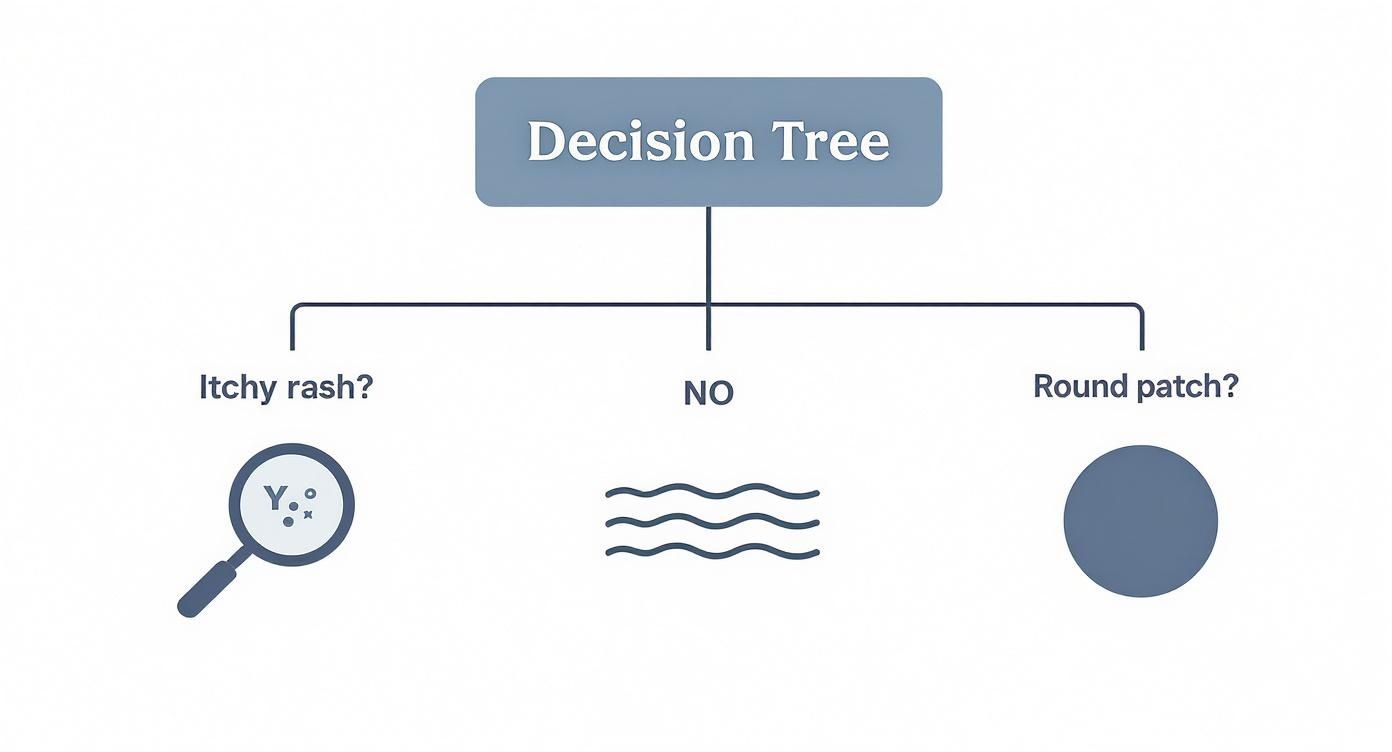
As the guide shows, paying attention to the pattern of the rash—like those tell-tale linear streaks—is a major clue that helps you distinguish a poison ivy reaction from other skin conditions.
Decontaminate Your Surroundings
Urushiol is incredibly resilient. That sticky oil can linger for months or even years on unwashed items, just waiting to cause another rash. You have to assume anything that might have touched the plant is contaminated.
That means washing your clothes, shoes, socks, garden gloves, and tools. Toss your clothes in the laundry using hot water and detergent. For your tools, a good wipe-down with rubbing alcohol or hot, soapy water should do the trick.
And don't forget the dog! If you think your pet might have romped through a patch of poison ivy, they need a bath. While they probably won't get a rash themselves, their fur is a perfect vehicle for carrying that urushiol right into your home and onto your skin.
For a deeper dive into what to do once a rash develops, check out The St. Louis Dermatology Guide to Treating Poison Ivy.
When You Should See a St. Louis Dermatologist
While many poison ivy rashes are miserable but manageable at home, some situations absolutely demand a professional’s eye. Knowing when to put down the calamine lotion and call a St. Louis dermatologist can save you from serious discomfort and prevent complications. At Mid-County Dermatology, we want our patients from Clayton to Chesterfield to know exactly when it's time to seek expert help.
A good rule of thumb is the "more than a quarter" rule. If the rash covers more than 25% of your body, it's time to call us. A widespread rash isn't just an inconvenience; it can overwhelm your body's ability to handle the intense inflammation on its own.
Urgent Care Scenarios
Location, location, location. When it comes to a poison ivy rash, where it pops up matters—a lot. Certain areas are immediate red flags that require a professional evaluation right away.
On Your Face: A rash anywhere on your face, particularly near your eyes or mouth, is a serious concern. Swelling in these areas can potentially interfere with your vision or even your breathing. Don't wait on this.
In the Genital Area: Rashes here are not only incredibly painful but also come with a higher risk of secondary infections and other complications.
Signs of a Severe Reaction: This is an emergency. If you experience facial swelling, have any difficulty breathing, or find it hard to swallow, you could be having a severe allergic reaction (anaphylaxis). Head to the nearest emergency room immediately.
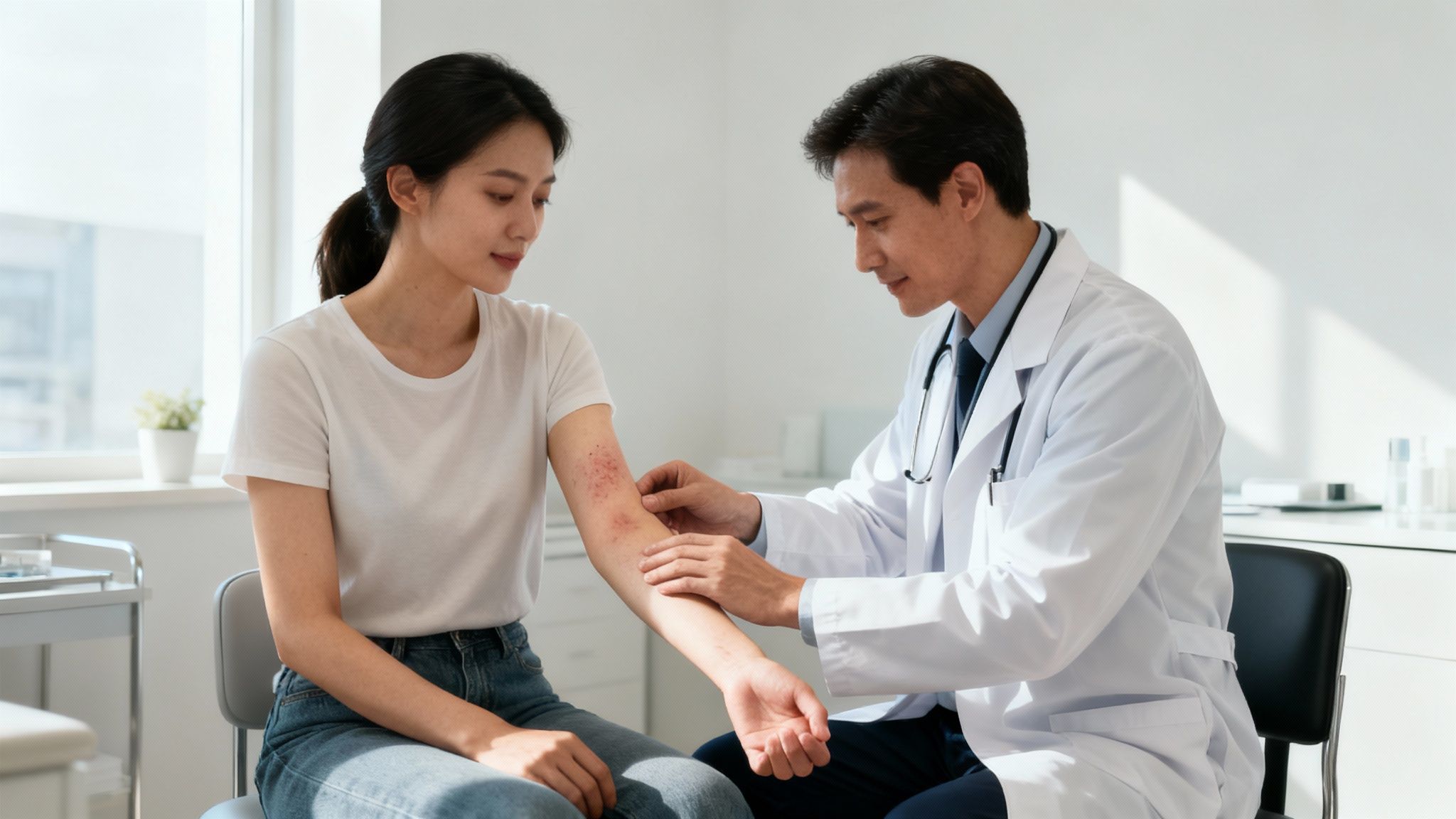
When Your Rash Becomes Infected
Another critical reason to see a St. Louis dermatologist is an infection. It's a common problem. The relentless itch leads to scratching, which can break the skin and create an open door for bacteria to march right in.
Keep a close eye out for these tell-tale signs of a secondary bacterial infection:
Pus or a thick, yellow fluid oozing from the blisters.
The area feels increasingly warm, painful, or looks more red and angry.
You develop a fever of 100°F (37.8°C) or higher.
An infection simply won't respond to over-the-counter itch creams. You'll need a prescription, likely an antibiotic, from a skin specialist like Dr. Feigenbaum or Dr. Gibstine at Mid-County Dermatology to clear it up properly.
"Patients often try to 'wait it out,' but a severe or infected rash won't resolve on its own. Prompt professional treatment with prescription-strength topicals or oral steroids is the fastest path to relief and prevents long-term scarring or skin changes."
Lastly, if you’ve been diligently trying at-home remedies for a week and things just aren't getting better, it’s time for a new game plan. There’s no need to suffer through weeks of misery when stronger, more effective treatments are just a visit away. Learning when to see a dermatologist for any skin issue is a crucial part of staying healthy. A quick trip to Mid-County Dermatology will get you a clear diagnosis and a treatment plan designed to get you comfortable and on the road to recovery.
Frequently Asked Questions About Poison Ivy Rash
As dermatologists in the St. Louis area, we get a lot of questions about poison ivy. It’s everywhere, from local parks to our own backyards. Below, we’ve answered some of the most common questions we hear at Mid-County Dermatology to clear up the confusion.
How do I know if I have a poison ivy rash?
You know you likely have a poison ivy rash if you see a very itchy, red rash that appears in streaks or lines 12 to 72 hours after being outdoors. The development of fluid-filled blisters is a key sign. The combination of intense itch, linear pattern, and blisters is the classic presentation we see in our St. Louis dermatology practice.
Can I get poison ivy from touching someone else's rash?
This is probably the biggest myth we have to bust. The rash itself is not contagious. The fluid that weeps from the blisters does not contain urushiol, which is the oily resin from the plant that triggers the allergic reaction. You can't "catch" poison ivy from another person's rash. If your rash seems to be spreading, it is more likely a delayed reaction in different areas or re-exposure from contaminated items.
How long does a poison ivy rash take to heal?
For most people, the rash will pop up anywhere from 12 to 72 hours after exposure. If it’s your first-ever encounter, your immune system might take up to three weeks to react. A mild case usually clears up within one to three weeks. A more severe reaction, especially one that needs a dermatologist's help, can take longer to resolve.
"Understanding the timeline is key. A delayed appearance doesn't mean you've been re-exposed; it's often just your immune system responding at a different pace. Patience is important, but if it's not improving after a week, it's time to seek professional advice from a St. Louis skin doctor." - Dr. Gibstine
When should I see a dermatologist for poison ivy?
You should see a board-certified dermatologist if the rash covers more than 25% of your body, is on your face or genital area, or shows signs of infection like pus or increasing pain. If you have difficulty breathing or facial swelling, seek emergency medical care immediately. The team at Mid-County Dermatology can provide prescription treatments like oral steroids to give you rapid relief.
What professional treatments are available for a severe rash?
When over-the-counter creams aren't enough, a St. Louis dermatologist at Mid-County Dermatology can help. For severe or widespread rashes, we may prescribe oral corticosteroids (like prednisone) to calm the intense inflammation, potent prescription-strength steroid creams, or antibiotics if the rash has become infected from scratching.
If you're struggling to identify or manage a rash, don't wait for it to get worse. The experts at Mid-County Dermatology are here to provide a clear diagnosis and an effective treatment plan. Schedule your appointment with a top St. Louis dermatologist today and get the relief you deserve. Learn more and book your visit at midcountyderm.com.
This information is for educational purposes only and does not constitute medical advice. Please consult with Dr. Feigenbaum, Dr. Gibstine, or another qualified healthcare provider at Mid-County Dermatology for personalized treatment recommendations. Individual results may vary.