
7 Warning Signs to Spot Early: A Guide to the Signs of Skin Cancer
When it comes to the signs of skin cancer, the single most important thing to watch for is change.
Pay attention to any new spot on your skin. Just as important is any existing spot that starts changing its size, shape, or color. Always trust your gut—if something on your skin just doesn't look or feel right, it’s worth getting it checked out.
What You Need to Know: A Quick Overview
Noticing a new or changing spot can feel a little scary, but knowing what to look for is the first step toward getting answers and taking control of your health. Skin cancer is the most common cancer in the United States, but the good news is that it's highly treatable when caught early.
This guide is designed to help you feel confident in what you’re looking for. Whether you're in Ladue, Clayton, or Creve Coeur, our goal is to empower you to do regular self-checks and know exactly when it’s time to call a St. Louis dermatologist. Dr. Feigenbaum and Dr. Gibstine at Mid-County Dermatology believe that patient education is the first line of defense.
The Three Main Types of Skin Cancer
To know what to look for, it helps to understand the main forms of skin cancer. Each one starts in a different type of cell in your skin's layers.
Basal Cell Carcinoma (BCC): This is the most common type. BCC often looks like a pearly or waxy bump, but it can also show up as a flat, flesh-colored patch. It tends to grow slowly and rarely spreads.
Squamous Cell Carcinoma (SCC): The second most common type, SCC usually appears as a firm red bump or a flat spot with a scaly, crusted surface.
Melanoma: While not as common, melanoma is the most serious because it's more likely to spread if it isn’t treated right away. It can develop from an existing mole or appear suddenly as a new dark spot.
Why Early Detection Matters So Much
Catching skin cancer in its earliest stages is everything. It makes treatment simpler and leads to much better outcomes.
For melanoma, the five-year survival rate is an incredible 99% when it’s found before spreading to the lymph nodes, according to the American Academy of Dermatology (AAD). That number alone shows the life-saving power of paying attention to your skin.
At Mid-County Dermatology, Dr. Feigenbaum and Dr. Gibstine always tell patients that they are the first line of defense. No one knows your skin better than you do, which makes your observations invaluable.
The numbers really put things into perspective. It's estimated that in 2025, over 212,000 new cases of melanoma will be diagnosed in the U.S. alone. Projections also show invasive melanoma will likely be the fifth most commonly diagnosed cancer for both men and women. Learn more about these melanoma projections.
This makes knowing the signs more critical than ever for our St. Louis community, from Chesterfield to Frontenac. If you ever notice something that worries you, a consultation with a St. Louis skin specialist can give you the clarity you need.
Decoding Melanoma With The ABCDE Method
When it comes to skin cancer, all warning signs are important, but melanoma is in a class of its own. It's the most serious form of skin cancer, so learning to spot its specific red flags early is absolutely critical. Thankfully, dermatologists have developed a simple but powerful memory tool to help you do just that.
This tool is the ABCDE method. Think of it as your personal checklist for examining your skin. It walks you through a systematic way to look at your moles and pinpoint any features that might be cause for concern. Getting comfortable with this method is a huge step in conducting effective self-exams and knowing exactly when to pick up the phone and call a St. Louis skin doctor.
A is for Asymmetry
First up, A stands for Asymmetry. Picture a normal, healthy mole. If you were to draw a line right down the middle, both halves would be mirror images of each other. They're generally symmetrical.
A mole that is asymmetrical, on the other hand, is a potential red flag for melanoma. When you imagine that same line down the middle, the two halves just don't match up. One side might be larger or have a completely different shape than the other. This lack of balance is a key sign to watch for.
B is for Border
Next, B is for the Border of the mole. A non-cancerous mole usually has a smooth, even, and well-defined border—like a perfect circle. You can easily tell where the mole stops and the surrounding skin begins.
A suspicious mole often tells a different story. Its border might be irregular.
The edges could look scalloped or have little notches.
The border might seem blurry and just sort of fade into your skin.
It may appear ragged or uneven, lacking that clear, distinct outline.
This kind of irregularity suggests the pigment cells aren't growing in an organized way, which is a common trait of melanoma. For a deeper look into these symptoms, you can learn more about the signs of melanoma in our detailed guide.
The flowchart below helps illustrate the main types of skin cancer, including melanoma, giving you a quick visual reference for what to look out for.
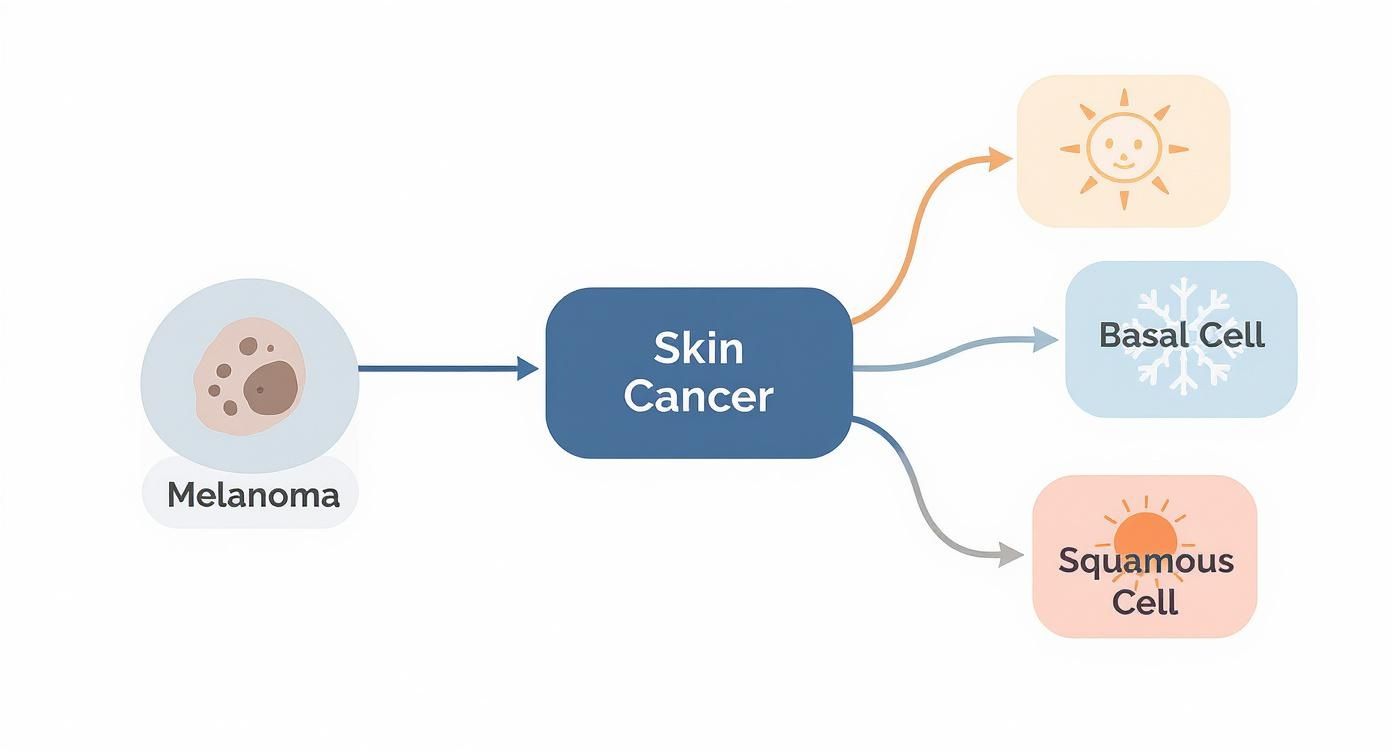
This guide is handy for differentiating between melanoma, basal cell, and squamous cell carcinoma by highlighting their unique characteristics.
C is for Color
The third letter, C, stands for Color. A harmless mole is typically one uniform shade of brown. It's consistent from one side to the other. Pretty simple.
A major warning sign is a mole that contains multiple colors. This isn't just one shade; you might see different shades of brown, tan, or black all within the same spot. In some cases, melanomas can even develop patches of red, white, or blue. This uneven color distribution is a strong signal that the mole needs a professional look.
D is for Diameter
D is for Diameter. Most benign moles are on the smaller side—typically smaller than a pencil eraser, which is about 6 millimeters (or 1/4 inch) across.
While it's true that melanomas can be smaller when they first appear, any mole that grows larger than 6mm should be on your radar. A larger diameter doesn't automatically mean it's cancer, but it definitely warrants closer attention, especially if it's paired with any of the other ABCDEs.
E is for Evolving
Finally, we have E for Evolving. This might be the most important sign of them all. "Evolving" simply refers to any change you notice in a mole over weeks or months.
A mole that's evolving might:
Change in size (getting bigger or, less often, smaller)
Change in shape (becoming more irregular)
Change in color (developing new shades or losing color)
Start to itch, bleed, or become crusty
Change is the ultimate red flag because cancer is, by nature, a process of change. Catching these evolving spots early is the key.
To make this easier to remember during your self-checks, here is a quick-reference table summarizing the ABCDEs.
The ABCDEs of Melanoma Detection
Letter | Stands For | What to Look For |
|---|---|---|
A | Asymmetry | One half of the mole does not match the other half. |
B | Border | The edges are irregular, ragged, notched, or blurred. |
C | Color | The color is not uniform and may include shades of brown, black, red, white, or blue. |
D | Diameter | The spot is larger than 6 millimeters across (about the size of a pencil eraser). |
E | Evolving | The mole is changing in size, shape, color, or is developing new symptoms. |
Keep this guide handy. It empowers you to know what you’re looking for and to recognize when it’s time to seek a professional opinion.
Beyond The ABCDEs: The Ugly Duckling Sign
There’s one more powerful concept that can help: the "Ugly Duckling" sign. It's a simple but effective idea. Take a look at the moles on your body. Most of them probably share a similar look—they're part of a "family."
The ugly duckling is the one mole that just looks different from all the others. Maybe it's much darker, significantly larger, or just has a different overall pattern. Trust your gut on this one. If a spot just doesn't seem to fit in with its neighbors, it's the one that deserves a closer look from a St. Louis dermatologist.
Recognizing Common Non-Melanoma Skin Cancers
While the ABCDEs are a fantastic tool for spotting melanoma, we also need to talk about its much more common—and often sneakier—cousins. Basal Cell Carcinoma (BCC) and Squamous Cell Carcinoma (SCC) are the two most prevalent types of skin cancer, and they don’t always play by the same rules as a dark, suspicious mole.
These non-melanoma cancers almost always show up on the skin that’s seen the most sun over the years. Think about your face, ears, neck, and the backs of your hands. Here in sunny St. Louis, knowing what to look for is a crucial skill, because many people brush these spots off as a harmless pimple, a patch of dry skin, or a small sore that just refuses to heal.
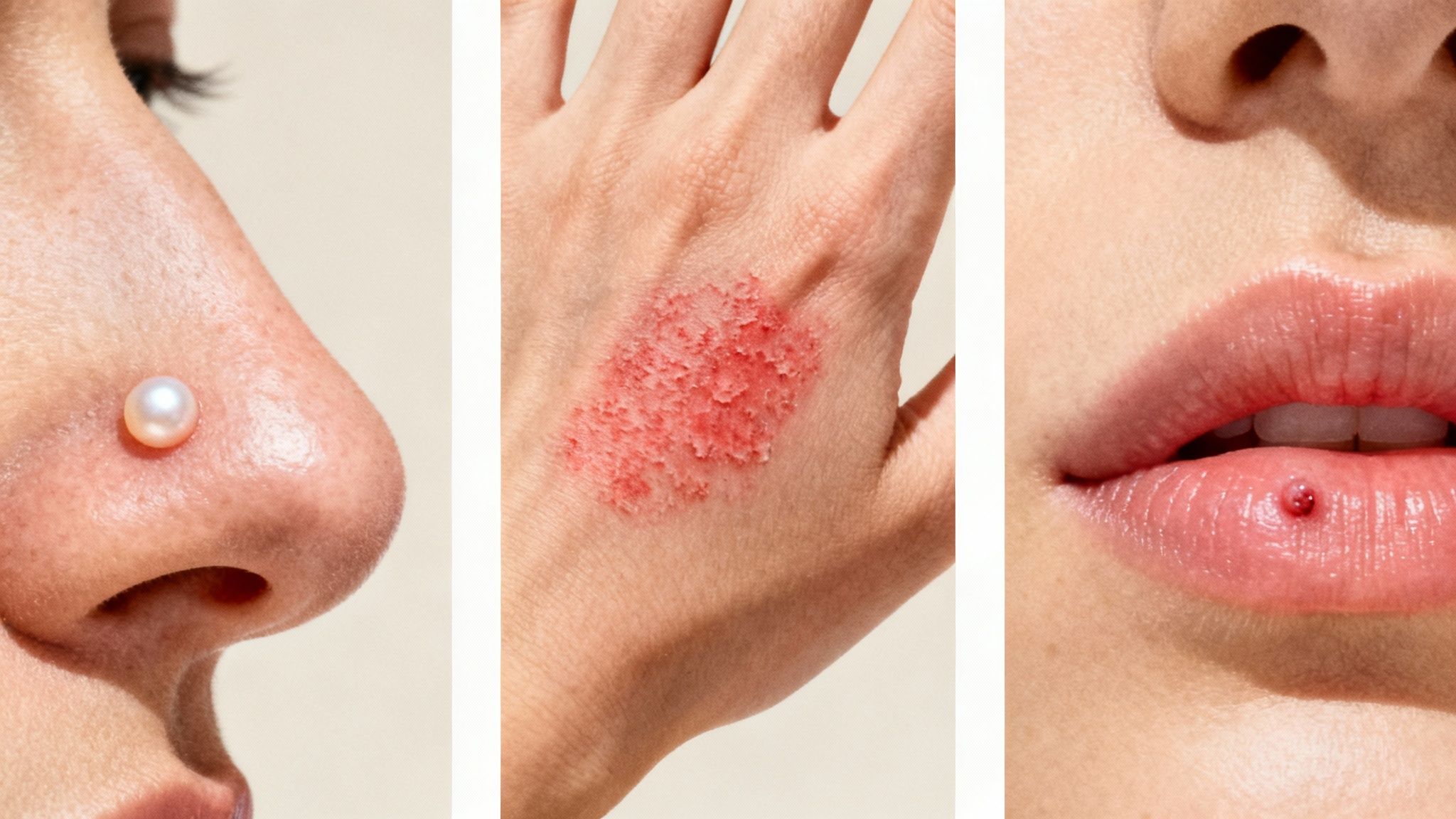
Unmasking Basal Cell Carcinoma
Basal Cell Carcinoma is the most common form of skin cancer on the planet, but it's a master of disguise. If there’s one unifying theme with BCC, it’s persistence. This is the spot that sticks around long after it should have disappeared.
Instead of having just one look, BCC can appear in a few different ways. Getting familiar with them is the best way to make sure nothing slips past your radar.
Common signs of BCC include:
A Pearly or Waxy Bump: This is the classic presentation. It often looks like a tiny, translucent, or skin-colored bump, sometimes with fine blood vessels visible just under the surface. It’s easy to mistake for a pimple that never quite comes to a head.
A Flat, Scar-Like Patch: Some BCCs look more like a flat, firm, and waxy area that resembles a scar. This type can be incredibly subtle, especially on the chest or face.
A Sore That Won't Heal: This is a major red flag. If you have a spot that bleeds, scabs over, heals a bit, and then breaks open again, it needs a professional look. This cycle is a tell-tale sign.
Here at Mid-County Dermatology, Dr. Feigenbaum and Dr. Gibstine see patients from all over St. Louis who come in with a "pimple" or "sore" that just won’t go away. That stubborn refusal to heal is often the key clue that points us toward BCC. For a deeper dive, you can learn more about Basal Cell Carcinoma in our expert explainer.
Spotting Squamous Cell Carcinoma
Squamous Cell Carcinoma is the second most common type of skin cancer. Like BCC, it thrives on sun-exposed skin, but it tends to have a rougher, more noticeable appearance. While it’s less aggressive than melanoma, SCC can grow deep into the skin and cause significant damage if it isn't treated promptly.
Think of SCC as a rough-and-tumble spot. It often has a distinct texture that you can feel, setting it apart from other marks on your skin.
"A key indicator for both BCC and SCC is any spot that is new and not healing as expected. Your skin has a remarkable ability to repair itself, so when a particular area fails to do so, it's sending a clear signal that something is wrong." – Dr. Connie Gibstine, Mid-County Dermatology
Key signs of SCC to watch for:
A Firm, Red Nodule: This might look like a small, rough bump that feels solid to the touch. It can grow quickly and may sometimes bleed or develop a crusty top.
A Flat Lesion with a Scaly, Crusted Surface: This often presents as a rough, reddish patch that can feel like sandpaper. It might be sensitive or even a little sore when touched.
A Sore on an Old Scar or Ulcer: SCC can sometimes pop up in areas where the skin has been previously injured, like an old burn or a scar that has been there for years.
Whether you're in Chesterfield or Frontenac, the sun’s cumulative damage is a major risk factor. Any new, rough, or non-healing spot is a good reason to schedule a visit with a St. Louis skin doctor. Catching these common skin cancers early makes treatment far more straightforward and effective.
How Skin Cancer Appears on Diverse Skin Tones
It’s a dangerous and persistent myth that skin cancer is only a concern for people with fair skin. The truth is, skin cancer can and does affect everyone, no matter their skin tone. But the signs can look completely different on skin of color, which makes knowing what to look for absolutely essential for catching it early.
One of the most critical differences is where skin cancer tends to show up. In individuals with darker skin tones, a particularly aggressive form of melanoma called acral lentiginous melanoma (ALM) is more common. What’s unique about ALM is that it’s not typically linked to sun exposure and often appears in the last places you’d think to check.
This includes spots like:
The palms of your hands
The soles of your feet
Underneath or around your fingernails and toenails
Because these areas aren’t what we usually associate with sun damage, ALM is often diagnosed at a later, more dangerous stage. A dark streak under a nail that won’t go away or a persistent sore on the bottom of your foot should never be ignored.
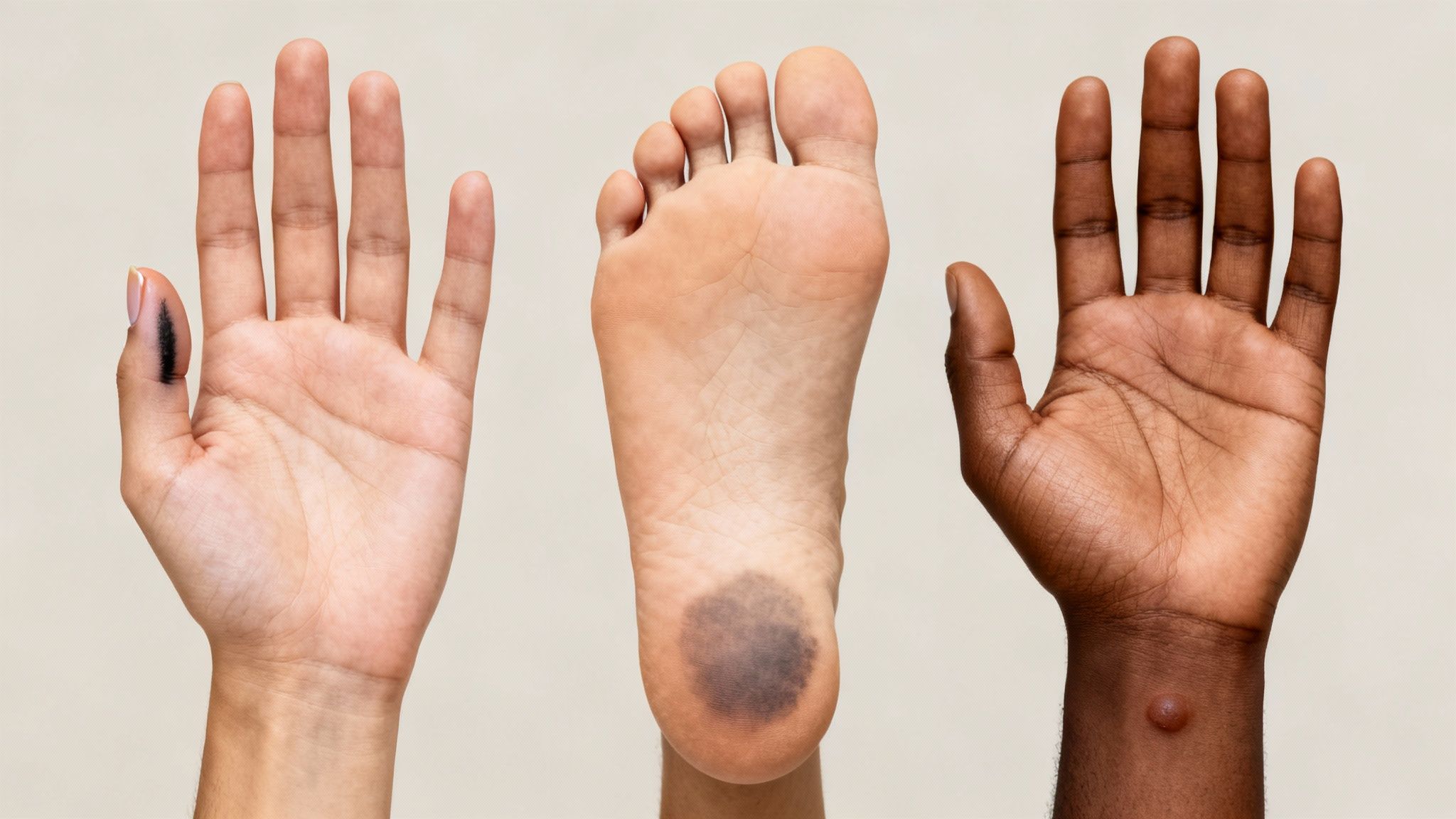
Different Appearances of Common Skin Cancers
The way other skin cancers look also changes on darker skin. Basal Cell Carcinoma (BCC), which most people picture as a pearly or pink bump, usually shows up as a pigmented brown or black bump on skin with more melanin. This often leads to it being mistaken for a harmless mole, which is why understanding the difference between moles and skin cancer is so important for self-monitoring.
Likewise, Squamous Cell Carcinoma (SCC) may not look like the classic scaly red patch. It can appear as a non-healing ulcer or a sore that just won’t go away, especially in areas where there has been previous scarring or inflammation.
"Every patient in St. Louis, from Ladue to Chesterfield, needs to know what is normal for their unique skin. On skin of color, we often look for any spot that is dark, growing, or simply won't heal, especially on the hands and feet." - Dr. Lawrence Feigenbaum, Mid-County Dermatology
Empowering Our Entire St. Louis Community
Since these signs can be much more subtle, it's vital for everyone to perform regular skin self-exams. That means paying close attention to every part of your body, not just the sun-exposed areas. Any spot that’s new, changing, or just seems unusual is worth a professional evaluation.
The dermatologists at Mid-County Dermatology have deep experience diagnosing and treating skin conditions across all skin types. As a leading St. Louis dermatology practice, we’re committed to providing inclusive, knowledgeable care for our entire community. If you have any concerns, the best thing you can do for your health is consult a St. Louis skin specialist who understands these crucial nuances.
When to Schedule a Skin Cancer Screening in St. Louis
Knowing the signs of skin cancer is your first line of defense, but knowing when to act is just as critical. Some changes on your skin are urgent warnings that need a dermatologist's attention right away, while other factors mean you should be getting regular, proactive skin checks.
The core message is simple: if a spot on your skin is worrying you, the safest thing to do is have it professionally evaluated. Dr. Feigenbaum and Dr. Gibstine at Mid-County Dermatology are here to provide that expert care and peace of mind.
Red Flags That Require an Immediate Appointment
Think of these symptoms as your skin’s alarm bells—they’re signaling that it’s time to see a St. Louis skin doctor right away. Don’t wait around to see if these signs will go away on their own.
Schedule an appointment if you notice a spot that:
Is Actively Changing: A mole or growth that is visibly changing in size, shape, or color over a few weeks or months is a major red flag.
Bleeds, Oozes, or Crusting: A spot that repeatedly bleeds from minor contact (like drying with a towel) or keeps developing a scab is not normal.
Is Itchy or Painful: While most skin cancers don't have symptoms, a spot that becomes tender, painful, or consistently itchy needs to be examined.
Is a Non-Healing Sore: Any sore that doesn't heal within a few weeks, or one that seems to heal and then reopens, is a classic warning sign, especially for non-melanoma skin cancer.
These symptoms suggest something is happening in the skin's cells that requires immediate professional attention.
Risk Factors That Call for Annual Skin Checks
Beyond any urgent symptoms, certain factors can increase your lifetime risk of developing skin cancer. If you fall into one or more of these categories, an annual full-body skin exam with a St. Louis dermatologist should be a non-negotiable part of your healthcare routine.
"A yearly skin exam is like a safety check for your body's largest organ. It allows us to track changes over time and catch potential issues at their most treatable stage, providing both a baseline for your skin's health and invaluable peace of mind." – Dr. Connie Gibstine, Mid-County Dermatology
Consider an annual screening if you have:
A Personal History of Skin Cancer: If you've had skin cancer once, your risk of developing another is much higher.
A Family History of Melanoma: Your risk increases if a first-degree relative (parent, sibling, or child) has had melanoma.
Numerous Moles: Having more than 50 moles on your body is a known risk factor.
Atypical Moles: These are moles that just look different—often larger, with irregular borders and multiple colors. They are a strong risk factor for melanoma.
A History of Significant Sun Exposure: This could be from a history of blistering sunburns (especially in childhood) or just spending a lot of time outdoors without protection.
A Weakened Immune System: Certain medical conditions or medications can suppress the immune system, making it harder for your body to fight off cancer cells.
Skin cancer is the most diagnosed cancer in the world, and melanoma is by far the most dangerous form. The numbers are climbing, with one analysis projecting a staggering 42% increase in invasive melanoma diagnoses in the United States between 2015 and 2025 alone. Learn more about the global trends in skin cancer diagnoses and the importance of early detection. Statistics like these really drive home why being proactive with screenings is so important.
What to Expect During Your Screening
Walking into a skin exam for the first time might feel a bit intimidating, but it’s a straightforward and non-invasive process. We have a full guide on what to expect during a skin cancer screening in St. Louis that breaks it all down.
Essentially, Dr. Feigenbaum or Dr. Gibstine will conduct a thorough, head-to-toe examination of your skin. They'll use a special magnifying tool called a dermatoscope to get a close-up, detailed look at any spots that catch their eye. The whole goal is to spot anything suspicious as early as possible, giving you the best chance for a simple solution and a great outcome.
FAQ: Your Skin Cancer Questions Answered
Even after you've learned the ABCDEs and the other warning signs, it’s completely normal to still have questions. Getting good at spotting potential signs of skin cancer is a skill, and it takes time and experience to feel confident in what you're seeing. Here at Mid-County Dermatology, we hear many of the same questions from patients all over the St. Louis area, from Chesterfield to Clayton.
To help you feel more prepared, we’ve put together the questions our board-certified dermatologists, Dr. Feigenbaum and Dr. Gibstine, answer most often.
What Is the Most Common Early Sign of Skin Cancer?
The single most common early sign is simply change. Your skin is always talking to you, and any new or changing spot is its way of flagging your attention. This could be a totally new mole that pops up or an old one that suddenly decides to look different.
For melanoma, the ABCDEs are your best friend for knowing what kind of change to watch for—in asymmetry, border, color, diameter, or evolution. For other skin cancers like basal cell carcinoma, that change might look like a pimple that refuses to heal or a new, pearly bump that just won't go away. The bottom line? Trust your gut. If something on your skin seems off, it’s worth having a St. Louis dermatologist at Mid-County Dermatology take a look.
Can a Skin Cancer Spot Appear Overnight?
This is a great question because it hits on a common fear. While it’s incredibly rare for a fully formed skin cancer to pop up literally overnight, some aggressive types, like nodular melanoma, can grow surprisingly fast—we're talking just a few weeks or months. That rapid growth can definitely make it feel like it came out of nowhere.
The real focus shouldn't be on an "overnight" timeline but on the speed of the change. Any spot that is visibly growing or changing over a matter of days or weeks is a major red flag. It’s a signal that something is happening on a cellular level that needs professional evaluation, and fast. If you notice a growth like this, it’s critical to schedule an appointment with a dermatologist in St. Louis right away.
Are Signs of Skin Cancer Always Visible, or Can They Be Painless?
The vast majority of early-stage skin cancers are completely silent. They usually don't cause any physical sensation at all—no itching, no tenderness, no pain. This is exactly why waiting for a spot to feel weird can be so risky.
If you wait for a mole to become painful or itchy, you could be giving the cancer time to advance. Your eyes are your most powerful tool here. You are looking for changes you can see, not waiting for a spot to feel different. This is why regular professional skin checks are so crucial for everyone in Creve Coeur, Ladue, and the greater St. Louis area. A board-certified skin specialist can spot visual clues long before any physical symptoms would ever show up.
How Can I Tell a Normal Mole from a Sign of Skin Cancer?
This is the million-dollar question. Distinguishing a normal, harmless mole from a potential problem comes down to one thing: consistency versus irregularity. Benign moles tend to follow the rules.
Think of a normal mole as being:
Uniform in Color: Usually just one consistent shade of brown.
Symmetrical: Generally round or oval.
Clearly Defined: It has a smooth, even border you can trace.
Part of a "Family": It looks pretty much like the other moles on your body.
A potential skin cancer, on the other hand, is a rule-breaker. It might be asymmetrical, have a blurry or jagged border, show off multiple colors, or be actively changing. This is where the "Ugly Duckling" sign is so helpful. When you scan your skin, does one mole just look... different from all the others? That's the one that needs a closer look.
When in doubt, the smartest and safest thing you can do is have the spot checked by a board-certified St. Louis dermatologist. Dr. Feigenbaum and Dr. Gibstine use tools like dermatoscopes to see beneath the skin's surface for an accurate diagnosis that the naked eye just can’t make.
Does an Itchy Mole Always Mean Cancer?
An itchy mole isn't an automatic sign of cancer, but it's definitely something you shouldn't brush off. Sometimes, a benign (non-cancerous) mole can get itchy from simple things like irritation from your clothes, dry skin, or a bit of inflammation.
However, itching can also be a sign that a mole is evolving—one of the key warnings in the ABCDEs of melanoma. As cancer cells grow, they can aggravate the nerve endings around them, which can cause itching or tenderness. The best way to handle it is to treat an itchy mole as a potential red flag, especially if it's also changing in shape, size, or color. Your St. Louis skin doctor at Mid-County Dermatology can figure out what's causing it and give you peace of mind.
At Mid-County Dermatology, our team is here to support you on your skin health journey. From routine screenings to expert diagnosis and treatment, Dr. Feigenbaum and Dr. Gibstine provide compassionate, patient-focused care for the entire St. Louis community. If you have a spot that concerns you, don't wait—schedule your consultation today.
This information is for educational purposes only and does not constitute medical advice. Please consult with Dr. Feigenbaum, Dr. Gibstine, or another qualified healthcare provider at Mid-County Dermatology for personalized treatment recommendations. Individual results may vary.


Comments