
How to Manage Oily Skin: A St. Louis Dermatologist's Guide
Managing oily skin is about consistency and using the right ingredients—not just throwing harsh, stripping products at the problem and hoping for the best. A gentle, steady routine that includes cleansing, an oil-free moisturizer, and daily sunscreen is your best bet for balancing sebum production. The goal isn't to eliminate oil completely, but to achieve a healthier, less shiny complexion.
Your Guide to Balanced Skin Starts Here
That constant midday shine, the enlarged pores, the feeling that your makeup has completely vanished by lunchtime—sound familiar? If you're nodding along, you’re definitely not alone. Here in St. Louis, from Clayton to Chesterfield, managing oily skin can feel like a relentless battle, especially as the seasons shift.
But what if you could achieve a balanced, healthy complexion without stripping your skin of its essential moisture?
This guide, crafted by the board-certified St. Louis dermatologists right here at Mid-County Dermatology, offers a realistic, science-backed approach. We’re moving past the temporary fixes to build a long-term strategy. It's all about combining the right daily habits, effective ingredients, and a few smart lifestyle tweaks. It’s time to learn how to work with your skin, not against it, for lasting comfort and confidence.
What You Need to Know: Oily Skin Quick Facts
What causes it? Oily skin is caused by overactive sebaceous glands producing excess sebum. This can be influenced by genetics, hormones, diet, and even stress.
What are the signs? Look for a persistent shiny or greasy appearance, enlarged pores (especially in the T-zone), and a tendency for blackheads and acne breakouts.
Best Ingredients: Salicylic acid, niacinamide, and retinoids are key for clearing pores and regulating oil production.
The Golden Rule: Don't skip moisturizer! A lightweight, oil-free moisturizer is crucial to keep skin hydrated and prevent it from overproducing oil to compensate for dryness.
When to See a Pro: If over-the-counter products aren't working after 8-12 weeks, or if you're experiencing painful cystic acne or scarring, it's time to consult a board-certified dermatologist.
Identifying the Signs of Oily Skin
Oily skin is more than just a little shine; it’s characterized by overactive sebaceous glands that can be easily triggered by environmental factors. It's such a common issue that the market for oil control lotions alone is projected to hit USD 5 billion in 2025. This boom is fueled by a growing desire for clear, healthy skin. You can dig deeper into the numbers in this full market research on oil control lotion.
This simple graphic shows a pretty typical day in the life of someone with oily skin.

As you can see, what starts as a fresh face can quickly lead to noticeable shine by lunch, and by the end of the day, you're often dealing with enlarged pores and makeup that has completely broken down.
At Mid-County Dermatology, Dr. Feigenbaum and Dr. Gibstine see patients from Ladue to Frontenac who are completely frustrated with this exact cycle. Our mission is to empower you with the knowledge to control that shine, not just cover it up. As leading St. Louis skin specialists, we believe that truly understanding your skin is the first and most important step toward finally achieving that balance you've been looking for.
Building Your Foundational Oily Skin Routine

A consistent, thoughtful routine is the absolute cornerstone of managing oily skin. It's a common myth that you need to attack shine with harsh, stripping products. The truth is, that aggressive approach often backfires, triggering your skin to produce even more oil as it desperately tries to rehydrate itself. The key is to find balance, not to wage a war on your face.
Crafting an effective skincare plan doesn't have to be a 10-step ordeal. For our patients at Mid-County Dermatology, whether they're in Ladue or Creve Coeur, we always emphasize a simple yet powerful framework. This approach hinges on gentle cleansing, smart hydration, and diligent protection to coax your skin into a healthier, more balanced state.
Your Morning Mission: Protection and Mattifying
Think of your morning routine as setting your skin up for success. The primary goal is to shield it from daily environmental stressors while keeping that excess oil in check.
First up, a gentle cleanser is your best friend. A gel or foaming formula is typically ideal for oily skin, as it does a great job of removing overnight oil buildup without stripping your skin's natural moisture barrier. Keep an eye out for ingredients like salicylic acid, which provides a bit of gentle exfoliation right inside the pores.
Next comes moisturizer—a step far too many people with oily skin are tempted to skip. This is a crucial mistake. A lightweight, non-comedogenic moisturizer is absolutely essential for keeping your skin hydrated. When your skin has the moisture it needs, your sebaceous glands are far less likely to go into overdrive. Formulas with hyaluronic acid are fantastic because they deliver a powerful dose of hydration without adding any extra oil.
Finally, the non-negotiable step: sunscreen. Sun damage not only accelerates aging but can also worsen oily skin and lead to stubborn post-inflammatory hyperpigmentation from breakouts. Always reach for a broad-spectrum, oil-free sunscreen with at least SPF 30.
Your Evening Task: Cleanse and Repair
Nighttime is your skin’s chance to reset. Your evening routine is all about thoroughly cleansing away the day's grime—makeup, pollutants, excess sebum—and then applying treatments that can work their magic while you sleep.
Always start with a deep cleanse to make sure your face is a perfectly clean slate. You can stick with the same gentle cleanser you used in the morning. This step is vital because it preps your skin to properly absorb the powerful ingredients that come next.
With your skin clean, it's time for targeted treatments. The evening is the perfect opportunity to bring in heavy hitters like retinoids, which are brilliant for regulating cell turnover and minimizing the appearance of pores. If you're new to retinoids, you can learn how to safely add them to your routine in our [dermatologist-approved guide for St. Louis skincare enthusiasts](https://www.midcountyderm.com/post/retinol-sandwiching-a-dermatologist-approved-guide-for-st-louis-skincare-enthusiasts).
"A consistent evening routine is critical," notes Dr. Feigenbaum, a trusted St. Louis dermatologist. "It allows active ingredients to work uninterrupted overnight, helping to regulate oil production and repair the skin for a clearer morning."
Wrap up your routine with that same lightweight, non-comedogenic moisturizer. This final layer locks in hydration and supports your skin's natural repair processes while you rest. The power of a good cleanse can't be overstated; in fact, cleansers account for a massive 46.5% of the skincare industry's value. You can [discover more insights about these skincare industry statistics](https://www.tricociuniversity.edu/beauty-blog/skincare-industry-statistics-2025-u-s-market-overview/) to see just how foundational this simple step really is for everyone.
To make things even clearer, let's break down how your morning and evening goals differ.
Your A.M. vs. P.M. Oily Skincare Routine
A comparison of the essential steps for your morning and evening skincare routines to effectively manage oil production throughout the day and night.
Step | Morning (A.M.) Goal | Evening (P.M.) Goal |
|---|---|---|
Cleanse | Remove overnight oil & sweat | Remove makeup, SPF, pollutants & daily grime |
Treat | Protect with antioxidants (like Vitamin C) | Repair with actives (like retinoids or acids) |
Moisturize | Hydrate and create a smooth, shine-free base | Hydrate and support overnight skin repair |
Protect | Shield skin from UV rays with SPF 30+ | N/A (Let skin breathe and repair) |
This side-by-side view helps illustrate the different but complementary roles your routines play. The morning is for defense, while the evening is all about correction and recovery.
Choosing Ingredients That Actually Control Oil
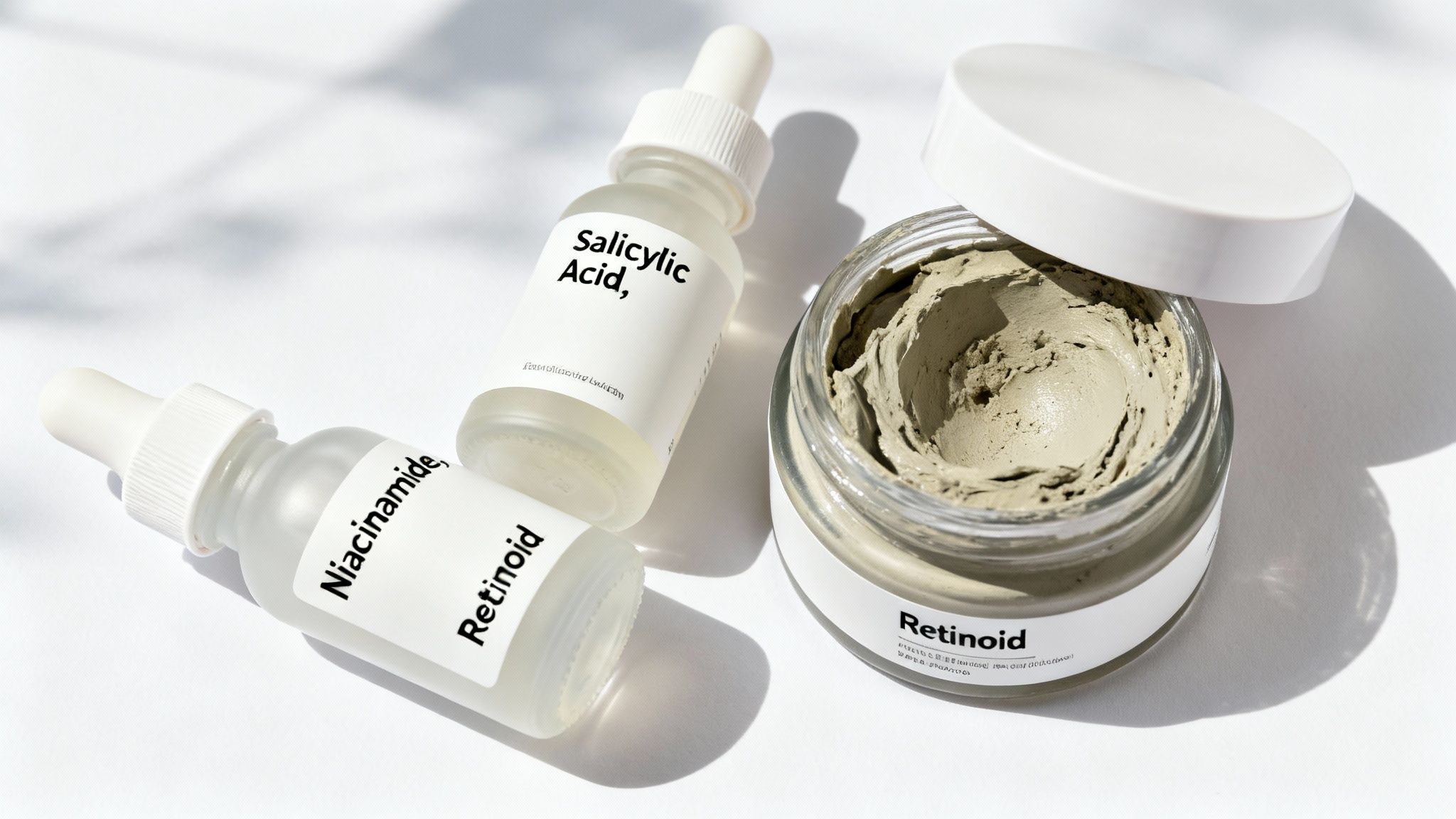
Navigating the world of skincare ingredients can feel like a full-time job. With endless options staring back at you from the shelf, it’s easy to get overwhelmed. But the secret to managing oily skin isn’t just about having a routine; it's about powering that routine with ingredients that are proven to work. At Mid-County Dermatology, we help our St. Louis patients cut through the noise by focusing on a few powerhouse actives.
These ingredients don’t just mop up the oil you see on the surface. They work deeper to regulate how much sebum your skin produces, clear out clogged pores, and improve your skin's overall texture. Learning what to look for on a product label is your first step toward gaining real control over that persistent shine.
Your Pore-Clearing Powerhouse: Salicylic Acid
If you have oily skin, salicylic acid needs to be on your radar. As a beta-hydroxy acid (BHA), it’s oil-soluble. That’s a fancy way of saying it can dive deep inside your pores to dissolve the sticky mix of oil and dead skin cells that leads to clogs and breakouts.
Unlike exfoliants that only work on the surface, salicylic acid gets right to the root of the problem. You can find it in cleansers, toners, and spot treatments. Using it consistently helps keep pores clear, which in turn makes them appear smaller and reduces the chance of acne forming. It's a true game-changer.
The Sebum-Regulating Multitasker: Niacinamide
Niacinamide, a form of vitamin B3, is a genuine superstar for oily complexions. It's incredibly versatile and helps regulate your skin's oil production over time. By bringing sebum into balance, it keeps your skin from looking greasy and can significantly minimize the appearance of enlarged pores.
But niacinamide does more than just control oil. It also strengthens the skin barrier and has anti-inflammatory properties, so it’s gentle enough for most people to use. This makes it a fantastic addition to any routine aimed at achieving a more balanced, even-toned complexion. For a deeper look, check out our [complete guide to niacinamide for skin](https://www.midcountyderm.com/post/niacinamide-for-skin-complete-benefits-guide-2025-what-dermatologists-want-you-to-know).
Advanced Solutions for Lasting Results
For those who feel like they've tried everything without success, a stronger approach might be needed. Certain ingredients and professional treatments offer more significant, lasting results.
Retinoids: These are the gold standard in dermatology for a reason. Retinoids (like over-the-counter retinol or prescription-strength tretinoin) speed up cell turnover. This process not only keeps pores clear but can also regulate oil gland function over the long term, a finding supported by research in publications like the Journal of the American Academy of Dermatology (2019).
Clay Masks: Don't underestimate the basics. Incorporating a clay mask once or twice a week is an excellent way to absorb excess surface oil and draw out impurities without being overly harsh.
Chemical Peels: For our patients in the Chesterfield and Frontenac areas looking for a reset, professional chemical peels can provide dramatic improvement. Performed by a St. Louis skin specialist, these treatments use acids to deeply exfoliate the skin, unclog pores, and reduce oil production.
The demand for effective solutions is undeniable. The global market for oily skin control products is projected to hit USD 11.6 billion by 2035, driven by a clear preference for dermatologist-tested, non-comedogenic formulas. Here in the USA, oil-free claims account for a staggering 51.5% of the market, which shows just how much people value products that won't clog their pores. You can [read the full research about these market trends](https://www.futuremarketinsights.com/reports/oily-skin-control-products-market) and see the data for yourself.
When over-the-counter products just aren't cutting it, a consultation with a St. Louis skin doctor like Dr. Feigenbaum or Dr. Gibstine can give you access to these more powerful, targeted solutions.
How Lifestyle and Diet Impact Oily Skin

While a stellar skincare routine is your first line of defense, what you do every day—and what you eat—plays a massive role in your skin's behavior. Getting oily skin under control isn't just about surface-level treatments. It's about a whole-body approach that creates balance from the inside out.
At Mid-County Dermatology, we often remind our St. Louis patients that simple lifestyle adjustments can be powerful tools for achieving long-term skin balance. This synergy between internal health and external care is often the missing piece for those struggling to control persistent shine and breakouts.
The Food and Sebum Connection
The link between what’s on your plate and how your skin behaves is becoming impossible to ignore. Certain foods can kickstart hormonal responses that directly ramp up oil production, creating a frustrating cycle for many.
High-glycemic foods are the main culprits here. Think sugary snacks, white bread, and other processed carbs that cause a rapid spike in your blood sugar. This surge prompts your body to release insulin and other hormones that can stimulate your sebaceous glands to produce even more oil. It's like adding fuel to the fire.
"A balanced, low-glycemic diet rich in whole foods is incredibly supportive for skin health. We see many patients in our St. Louis dermatology practice who notice a real improvement in oiliness and breakouts after making mindful dietary changes." Dr. Connie Gibstine, Board-Certified St. Louis Dermatologist
Making simple swaps can make a world of difference. Understanding the [benefits of quitting sugar for clearer skin](https://stopsugar.app/blog/benefits-of-quitting-sugar) can be a real eye-opener. For a deeper dive, our St. Louis skin specialists have detailed information in our article on [how the right diet can help with acne](https://www.midcountyderm.com/post/can-the-right-diet-get-rid-of-acne).
Stress and Its Impact on Your Skin
Ever notice how a stressful week often leads to a surprise breakout? That's not a coincidence. When you're stressed, your body pumps out more cortisol, a hormone that can send your oil glands into overdrive. This hormonal surge is a major trigger for oily skin and acne flare-ups.
Finding effective ways to manage stress isn't just good for your mind—it's essential for your skin. Try incorporating some of these practices into your routine:
Regular Exercise: Getting your body moving improves circulation and helps keep hormones in check.
Mindfulness and Meditation: Even just a few minutes a day can lower those cortisol levels.
Adequate Sleep: Aim for 7-9 hours a night. This is when your body and skin do their most important repair work.
When you combine these lifestyle adjustments with a targeted skincare routine, you create a powerful, comprehensive strategy. By addressing both the internal triggers and the external symptoms, you can manage oily skin far more effectively for a healthier, more balanced complexion.
When Your Oily Skin Needs a Dermatologist
A dedicated at-home routine can work wonders for managing oily skin. Honestly, it’s the foundation of everything. But there are definitely times when over-the-counter products just aren’t cutting it, no matter how consistent you are. If you feel like you've tried everything and are still struggling, it might be time to call in a professional.
Sometimes, the signs are pretty clear. We’re talking about persistent breakouts that just laugh at your spot treatments, painful cysts that form deep under the skin, or the start of acne scars. Trying to tackle these issues on your own can be a frustrating, uphill battle that might even make things worse.
Recognizing the Need for Expert Care
Knowing when to escalate your skincare from the bathroom counter to the doctor's office is crucial. If you're nodding along to any of the following, a consultation with a St. Louis skin specialist is your best next move.
Persistent Acne: You’ve been diligently using over-the-counter treatments with salicylic acid or benzoyl peroxide for 8-12 weeks, but the breakouts just keep coming.
Cystic or Nodular Acne: These aren't your average pimples. They are large, painful bumps deep under the skin that almost never respond to topical products and carry a high risk of scarring.
Developing Scars: You're noticing pitted scars or dark spots (post-inflammatory hyperpigmentation) that stick around for months after a blemish finally heals.
Impact on Your Confidence: This one is just as important. When your skin is negatively affecting your self-esteem or daily life, that's more than enough reason to seek professional help.
For a deeper dive, you can check out our guide on [the top signs you should see a dermatologist](https://www.midcountyderm.com/post/when-to-see-a-dermatologist-6-signs-you-should-know).
What to Expect at a Dermatology Consultation
Scheduling a visit with a board-certified St. Louis dermatologist at Mid-County Dermatology is a huge step toward getting your skin back in balance. Dr. Feigenbaum and Dr. Gibstine provide personalized care for patients from Clayton to Chesterfield, and it all starts with a simple conversation. We’ll take a close look at your skin and talk through your concerns and everything you’ve tried so far.
A professional diagnosis is key. What looks like simple oily skin could be linked to an underlying condition. We can also provide access to prescription-strength treatments that are far more effective than anything you can buy in a store.
Based on that evaluation, we’ll build a precise treatment plan just for you. This could involve powerful options like prescription retinoids (think tretinoin), oral medications to regulate hormones or oil production, or even in-office procedures like chemical peels. Partnering with a St. Louis skin doctor means your plan is safe, effective, and designed specifically for your skin's unique needs.
Key Takeaways: Your Oily Skin Action Plan
Cleanse Gently, Twice Daily: Wash your face in the morning and evening with a foaming or gel-based cleanser to remove excess oil without stripping the skin.
Never Skip Moisturizer: Use a lightweight, oil-free, non-comedogenic moisturizer to keep your skin hydrated and prevent it from overproducing sebum.
Use the Right Actives: Incorporate ingredients like salicylic acid, niacinamide, and retinoids into your routine to clear pores and regulate oil.
Sunscreen is Non-Negotiable: Protect your skin daily with a broad-spectrum, oil-free sunscreen with at least SPF 30.
Consider Lifestyle Factors: Pay attention to diet and stress levels, as they can significantly impact oil production.
Know When to See a Pro: If OTC products fail or acne becomes severe, consult a board-certified dermatologist at Mid-County Dermatology for personalized, prescription-strength solutions.
Answering Your Questions About Oily Skin
Even with a solid game plan, questions about oily skin always come up. To give you some more clarity, we asked our board-certified St. Louis dermatologists, Dr. Feigenbaum and Dr. Gibstine, to answer the most common questions we hear from patients right here at our Mid-County Dermatology practice. Think of these as quick, expert answers to help you fine-tune your approach for good.
Will Moisturizer Make My Skin Greasier?
This is probably the biggest myth we have to bust, and the answer is a hard no—as long as you’re using the right one. In fact, skipping moisturizer can make oily skin worse. When your skin gets dehydrated, it goes into panic mode and starts pumping out even more oil to compensate.
The trick is to find a formula that gives your skin the water it needs without piling on extra oil or weight.
What to look for: Lightweight, oil-free, and non-comedogenic moisturizers are your best friends. Gel or fluid lotion textures usually feel amazing on oily complexions.
Hero Ingredients: Keep an eye out for humectants like hyaluronic acid and glycerin. These are fantastic because they hydrate by pulling water into the skin, not by coating it with a greasy film.
Can I Get Rid of Large Pores Permanently?
Pore size is mostly genetic, so you can't technically shrink them forever. But you can absolutely make them look much smaller and less obvious. Pores appear larger when they get stretched out by all the things that get trapped inside them: oil, dead skin cells, and daily grime.
"A consistent routine that keeps your pores clear is the single most effective way to minimize their appearance. Think of it less as 'shrinking' and more as 'refining' what you have."– Dr. Connie Gibstine, Board-Certified St. Louis Dermatologist
This is where ingredients like salicylic acid and retinoids really shine. They work by exfoliating from inside the pore, clearing out the gunk that makes them look so prominent. For patients in the Creve Coeur or Ladue area looking for a bigger impact, professional treatments from a trusted St. Louis skin doctor can deliver some pretty dramatic results.
How Often Should I Wash My Face?
It’s so tempting to scrub away the shine multiple times a day, but that strategy almost always backfires. Over-washing strips your skin of its natural oils, which messes with its protective barrier. This sends an emergency signal to your oil glands to go into overdrive to make up for what's been lost.
For most people with oily skin, washing twice a day is the sweet spot.
In the morning: A quick cleanse is perfect for whisking away any oil and sweat that built up overnight.
In the evening: This cleanse is non-negotiable. It removes makeup, sunscreen, pollutants, and all the buildup from the day.
If you’ve had a really intense workout, a third cleanse is fine. Just be sure to always use a gentle, sulfate-free cleanser and lukewarm water to avoid irritation. Harsh scrubbing is never the solution.
Does My Diet Really Affect My Oily Skin?
For a lot of people, the answer is a definite yes. While the connection is different for everyone, a growing body of evidence, including studies noted by the American Academy of Dermatology (AAD), confirms the link. The usual suspects are often high-glycemic foods—things like white bread, sugary snacks, and other processed carbs.
These foods cause your blood sugar to spike, which triggers a hormonal response in your body that can ramp up oil production. Some people also find that dairy is a personal trigger. You don't need to adopt a super restrictive diet, but shifting your focus to whole foods, lean proteins, fruits, and vegetables supports overall skin health. It's a huge piece of the puzzle when learning how to manage oily skin from the inside out.
Ready to build a personalized plan to get your oily skin under control? The board-certified St. Louis dermatologists at Mid-County Dermatology are here to help you finally achieve a balanced, healthy complexion. Schedule your consultation today.
This information is for educational purposes only and does not constitute medical advice. Please consult with Dr. Feigenbaum, Dr. Gibstine, or another qualified healthcare provider at Mid-County Dermatology for personalized treatment recommendations. Individual results may vary.


Comments